








Enovis Corporation, a leading medical technology company specializing in orthopedic solutions, has announced a definitive agreement to acquire eCential Robotics, a France-based pioneer in surgical robotics and navigation. This strategic move is designed to accelerate Enovis’s roadmap for enabling technologies, specifically targeting the high-growth sectors of robotic-assisted knee and shoulder surgeries. By integrating eCential’s proprietary robotic platform into its existing Astra ecosystem, Enovis intends to challenge established industry leaders with a next-generation suite of surgical tools designed for precision, agility, and improved patient outcomes.
The acquisition marks a significant pivot for Enovis as it seeks to close the technological gap with major competitors such as Stryker, Johnson & Johnson, and Zimmer Biomet. Under the terms of the agreement, Enovis will pay an upfront fee followed by contingent milestone payments totaling up to 35 million euros. These milestones are specifically tied to the successful development and regulatory approval of a knee robotic system and a shoulder robotic system, signaling a clear performance-based structure to the deal.
Strategic Foundations and the Astra Ecosystem
Enovis operates through two primary business segments: its reconstructive division, which focuses on surgical implants for bone and joint repair, and its prevention and recovery division, which provides rehabilitation and physical therapy products. In recent years, the company has prioritized "enabling technologies"—a category that includes surgical navigation, augmented reality (AR), and robotics—as the cornerstone of its long-term growth strategy.
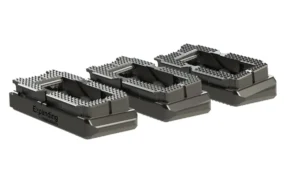
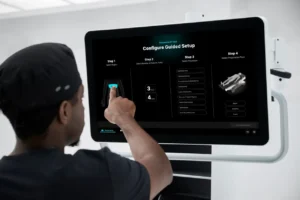
The Astra platform currently serves as Enovis’s flagship digital health suite. It includes advanced procedure planning software and an augmented reality headset that provides surgeons with real-time data overlays during operations. However, the absence of a dedicated robotic arm has been a notable omission in a market where robotic assistance is becoming the standard of care for joint replacement. CEO Damien McDonald emphasized to investors during a recent earnings call that bringing robotics in-house is essential for maintaining "agility" in product development. By owning the hardware and software development cycles, Enovis can more rapidly iterate based on clinician feedback, rather than relying on third-party partnerships.
A Targeted Timeline for Market Entry
The acquisition of eCential Robotics provides Enovis with a concrete timeline for its entry into the competitive robotics space. The company has laid out a multi-year development plan that reflects the complexity of bringing high-precision medical machinery to market:
- Phase One (2024–2026): Integration of eCential’s engineering and software teams into the Enovis Reconstructive business group. This period will focus on refining the interoperability between Enovis’s Astra software and eCential’s robotic arm.
- Phase Two (Late 2028): The projected commercial launch of the Enovis knee robot. This system will enter a mature market currently dominated by Stryker’s Mako and Zimmer Biomet’s ROSA systems.
- Phase Three (2029): The launch of the Enovis shoulder robot. This is viewed by the company as a potential "category killer," as the shoulder robotics market is currently less saturated and technologically fragmented compared to the knee and hip sectors.
The decision to target 2028 and 2029 suggests that Enovis is prioritizing a robust, differentiated product over a rushed market entry. Louie Vogt, Group President of the Reconstructive Business Group at Enovis, noted that the extra development time would allow the company to incorporate "subtle nuances" and features that address existing pain points in robotic surgery, such as bulky equipment and long setup times.
The Technical Edge: Overcoming Shoulder Surgery Challenges
While the knee robotics market is well-established, Enovis leadership believes the shoulder market represents the most significant opportunity for disruption. Currently, shoulder procedures are served by systems such as Smith & Nephew’s CORI, Stryker’s Mako, and Zimmer Biomet’s ROSA. However, McDonald has described the current market offerings in the shoulder space as "suboptimal" in terms of form factor and flexibility.
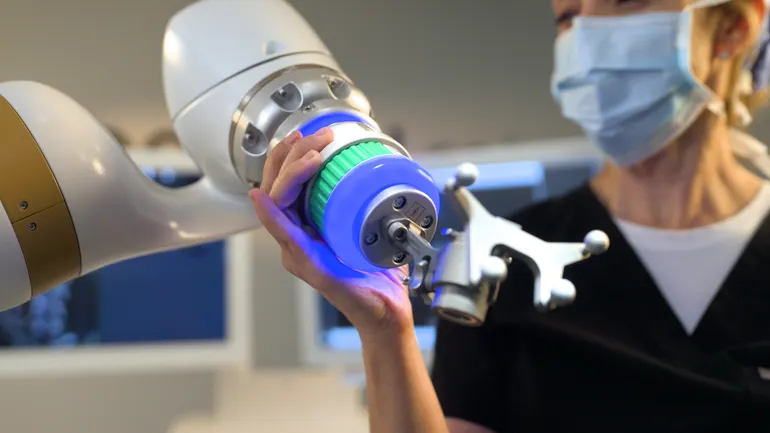
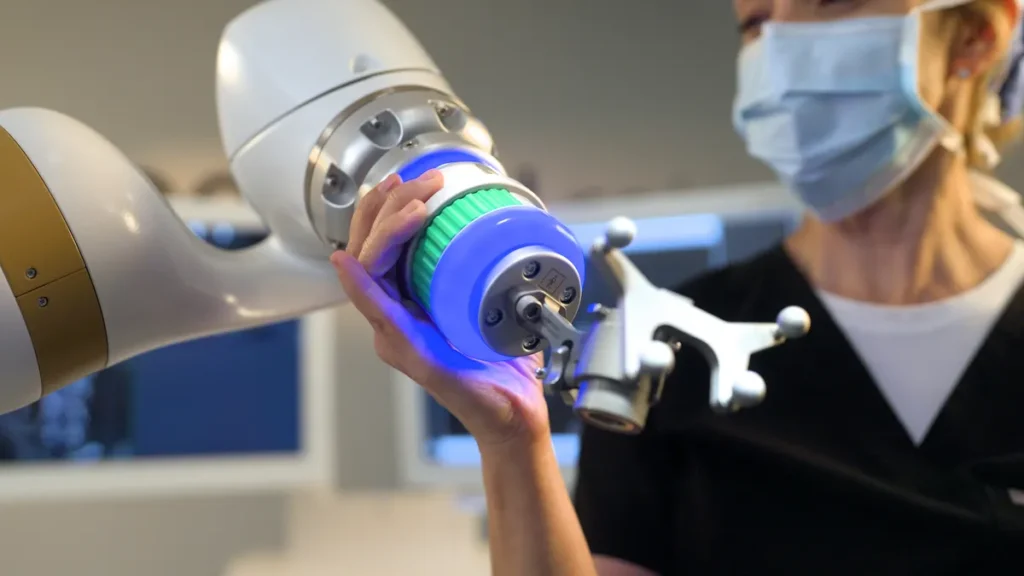
The eCential platform is expected to provide Enovis with a robotic arm featuring seven degrees of freedom. In robotics, "degrees of freedom" refers to the number of independent movements a joint or arm can make. A seven-degree-of-freedom system offers a level of dexterity that mimics a human arm, allowing for better maneuverability in the tight, complex anatomical spaces of the shoulder joint. This increased range of motion is expected to allow surgeons to perform more precise resections and implant placements, potentially leading to faster recovery times and better long-term joint stability for patients.
The eCential Advantage: A Proven Track Record in Surgical Navigation
Based in Grenoble, France, eCential Robotics has built a reputation as a specialist in the "open" robotics model. Unlike some competitors who lock their robots to specific implant brands, eCential has historically worked to create platforms that can be adapted for various surgical needs. The company currently employs approximately 50 specialists, including high-level software engineers, hardware designers, and regulatory experts.
Crucially, eCential was a key partner in the development of Johnson & Johnson’s VELYS robotic-assisted solution. This historical connection provides a level of market validation for Enovis. Analysts at BTIG have noted that because eCential’s core technology has already been utilized in successful commercial systems, the "market acceptance is de-risked." The acquisition allows Enovis to inherit a team that already understands the rigors of FDA and CE mark approval processes, as well as the manufacturing requirements for high-precision surgical robots.
Vogt confirmed that eCential’s existing facility in France has the capacity to produce between 75 and 100 robots annually. This manufacturing footprint provides Enovis with an immediate European base for production and R&D, which could prove vital as the company seeks to expand its global market share.
Financial Implications and Investor Reactions
Despite the strategic logic of the deal, the financial markets reacted with caution. Following the announcement, Enovis shares fell by 16.5%, closing at $20.53. The primary concern among investors appears to be the short-to-medium-term impact on the company’s profit margins.
Enovis Chief Financial Officer Ben Berry acknowledged that the acquisition and the subsequent R&D investment required to reach the 2028 and 2029 launch dates would likely suppress margins through 2027. The heavy capital expenditure (CapEx) associated with robotic development often creates a "valuation gap" where current earnings are sacrificed for future growth potential.
Analysts from BTIG expressed a measured view, stating they were "not thrilled" about the hit to margins but recognized that Enovis’s current valuation perhaps did not fully reflect the progress the company was already making in its reconstructive business. The consensus among medtech analysts is that while the acquisition creates a "wait-and-see" period for the stock, it is a necessary move to ensure Enovis remains relevant in a decade where "analog" surgery is being rapidly replaced by "digital" surgery.
Navigating a Competitive Global Landscape
The orthopedic robotics market is currently experiencing a period of intense consolidation and innovation. The "Big Four"—Stryker, DePuy Synthes (Johnson & Johnson), Zimmer Biomet, and Smith & Nephew—collectively control the vast majority of the global market. These companies have spent billions of dollars over the last decade acquiring robotic startups (such as Stryker’s $1.65 billion acquisition of Mako Surgical in 2013) to build their ecosystems.

For Enovis, the challenge is not just building a functional robot, but building a better "mousetrap" that can convince hospitals to switch from their current providers. Hospital systems often invest millions in a specific robotic platform and train their surgical staff on its software. To overcome this "switching cost," Enovis will need to prove that its Astra-eCential integration offers superior clinical outcomes or a lower total cost of ownership.
The focus on the shoulder market is a tactical choice. Total shoulder arthroplasty is one of the fastest-growing segments in orthopedics, driven by an aging population and a rise in active lifestyles among seniors. By positioning itself as a "shoulder-first" robotics company, Enovis could carve out a niche that the larger players have treated as secondary to the massive hip and knee markets.
Looking Ahead: The Future of Enabling Technologies in Orthopedics
The acquisition of eCential Robotics by Enovis is emblematic of a broader trend in the medical device industry: the shift from being an implant manufacturer to a "solutions provider." In the modern operating room, the implant itself—the metal and plastic that replaces the bone—is increasingly seen as a commodity. The real value, and the real profit, is found in the digital ecosystem that ensures the implant is placed perfectly.
By 2029, if Enovis hits its milestones, the company will offer a comprehensive digital surgery suite. A surgeon could theoretically use Enovis software to plan a surgery in 3D, use Enovis AR glasses to visualize the patient’s internal anatomy, and use an Enovis-eCential robot to execute the procedure with sub-millimeter precision—all while using Enovis implants.
This end-to-end integration is the "holy grail" of orthopedic medtech. While the financial road to 2027 may be characterized by compressed margins and investor skepticism, the long-term vision presented by McDonald and his team is clear: Enovis is betting that the future of orthopedics is not just in the hands of the surgeon, but in the software and robotics that guide them.
As the integration of eCential proceeds, the industry will be watching closely to see if this smaller, more agile player can indeed disrupt the giants of the orthopedic world. With the knee robot launch set for 2028 and the shoulder robot following in 2029, the next five years will be a defining period for Enovis Corporation.