


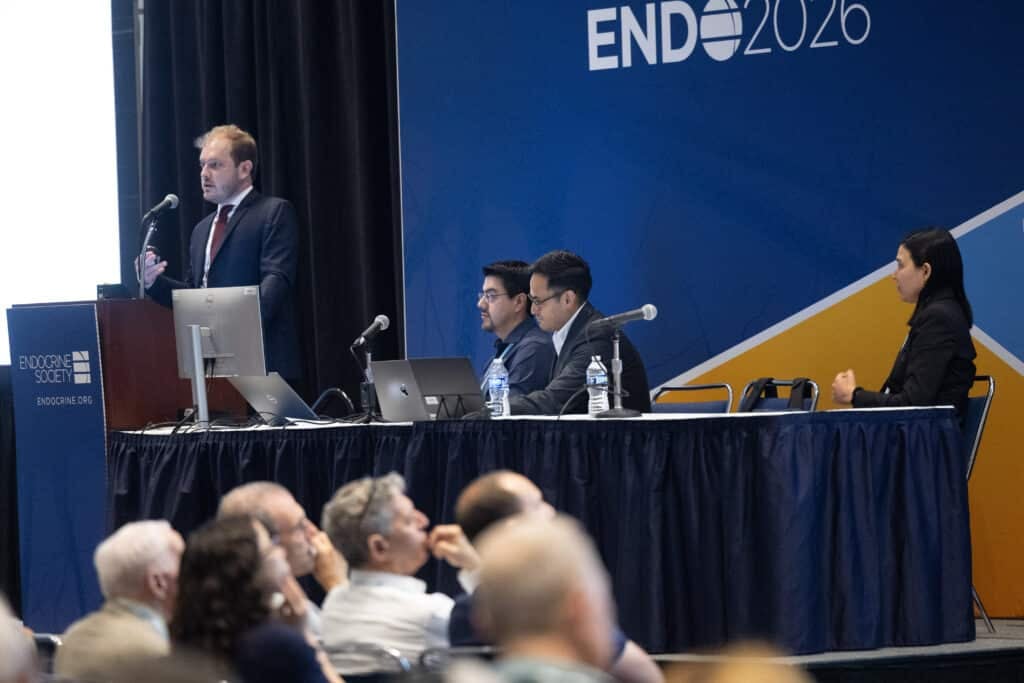
The medical landscape is currently undergoing a transformative shift as artificial intelligence (AI) transitions from a technological novelty into a fundamental clinical necessity. This evolution was the focal point of a high-profile session at ENDO 2026, the Endocrine Society’s annual meeting, held on Saturday, June 13th. Titled "Artificial Intelligence in Endocrinology: Practical Uses, Lessons Learned, and What Comes Next," the session brought together leading researchers and clinicians to dissect the current state of AI integration in hormonal health and metabolic medicine. The overarching message was clear: the AI revolution is no longer a distant prospect but a present reality, and healthcare providers who delay their engagement with these tools may soon find themselves at a significant disadvantage in a rapidly advancing field.
The session was chaired by Juan P. Brito, MD, MSc, a professor of medicine and director of the Care and AI Laboratory at the Mayo Clinic. Dr. Brito, who also serves as the medical director of the Shared Decision Making National Resource Center, emphasized that the presentation was designed to bridge the gap between theoretical potential and bedside application. By connecting practical tools available for immediate use with the systemic lessons learned from early implementation, the session provided a comprehensive roadmap for endocrinologists navigating this new digital frontier.
The Rise of Everyday AI in Clinical Practice
The first segment of the session, led by David Toro-Tobón, MD, a Mayo Clinic Scholar and assistant professor of medicine, focused on what he characterizes as "Everyday AI." This term refers to the suite of generative AI and chatbot technologies that can be integrated into the current workflow of an endocrinologist without requiring massive infrastructure overhauls. These include AI-powered medical scribes, administrative support tools for research documentation, and point-of-care decision aids like OpenEvidence, which assist in rapid data retrieval and clinical synthesis.

Dr. Toro-Tobón challenged the prevailing narrative that AI serves as a replacement for human expertise. Instead, he argued that AI functions through a fundamentally different intelligence architecture that complements human reasoning. While human intelligence excels at contextual nuance, empathy, and complex ethical judgment, AI excels at processing vast datasets and performing repetitive cognitive tasks with high speed. By offloading the "cognitive load" of administrative and routine tasks to machines, clinicians can reclaim the time necessary for direct patient interaction—the core of the medical profession that many feel has been eroded by the digital age.
However, this transition is not without its hazards. Dr. Toro-Tobón warned that an improper understanding of AI risks could exacerbate clinician workload or lead to patient harm. He specifically cited "hallucinations"—instances where AI models generate confident but factually incorrect information—as a primary concern. The stakes in healthcare are significantly higher than in general business applications, necessitating a much lower tolerance for error and a more rigorous approach to tool selection.
Data Privacy and the HIPAA Compliance Gap
A critical takeaway from the session involved the nuanced and often misunderstood world of data security. Dr. Toro-Tobón highlighted a dangerous misconception regarding "business-compliant" versus "HIPAA-compliant" software. Many health systems utilize AI tools embedded within enterprise software suites that feature "green shields" or language suggesting data protection. While these tools may prevent the data from being used to train general models—making them safe for business-confidential information—they do not automatically meet the stringent regulatory requirements of the Health Insurance Portability and Accountability Act (HIPAA) for protecting patient health information (PHI).
The distinction is vital: using patient data in a tool that has not been specifically vetted, approved, and contractually bound for healthcare use puts both the patient and the institution at risk. Dr. Toro-Tobón noted that even tools designed with HIPAA compliance in mind, such as Doximity Ask, often rely on individual National Provider Identifier (NPI) numbers. This creates a personal agreement between the provider and the tool, which may conflict with institutional policies, as the patient data technically belongs to the healthcare system rather than the individual clinician. This legal and ethical complexity underscores the need for "exceptional" standards in healthcare AI, where "good enough" is a recipe for catastrophic failure.

The Three Pillars of AI Implementation
Following the discussion on practical tools, Naykky M. Singh Ospina, MD, a professor at the University of Florida, shifted the focus toward implementation science. Her research explores why some AI innovations successfully integrate into the clinic while others fail to gain traction. She organized the challenges facing AI adoption into three distinct pillars:
- Technical Maturity: AI models must be capable of handling the longitudinal, context-heavy, and often uncertain nature of endocrine disorders. Many current models struggle with the "gray areas" of medicine where patient history and environmental factors heavily influence outcomes.
- Clinical Evidence: A tool’s ability to make a prediction is insufficient. It must demonstrate a measurable improvement in patient outcomes. Without evidence that AI leads to better health or higher quality of life, clinical adoption remains ethically questionable.
- Sociotechnical Implementation: This involves the human element—building trust among patients and clinicians and ensuring that tools fit seamlessly into the existing clinical workflow.
Dr. Singh Ospina noted that these pillars are interdependent. Progress in technical development is futile if clinicians do not trust the output, and trust cannot be established without robust clinical evidence. This creates a circular challenge that requires multidisciplinary collaboration from the very beginning of the development process.
Success and Failure: A Tale of Two Applications
To illustrate these pillars in action, Dr. Singh Ospina presented a comparative analysis of two AI applications in endocrinology: diabetic retinopathy screening and thyroid ultrasound assessment.
The use of AI for diabetic retinopathy is considered a landmark success. The technology is FDA-approved and addresses a specific "point of friction" in patient care. Traditionally, patients required separate appointments with specialists for retinal imaging, leading to high rates of non-compliance. The AI tool allows for immediate screening within the primary endocrine clinic; if the system flags high-risk findings, a follow-up can be scheduled before the patient even leaves the building. This application succeeds because it is technically sound, improves clinical adherence (an outcome), and is supported by billing codes and clinical guidelines (implementation).

In contrast, AI tools for thyroid ultrasound assessment have struggled to achieve similar widespread adoption. While several models can analyze nodules and flag cancer risks, they have not yet proven to improve overall care or reduce unnecessary biopsies across diverse patient populations. Many of these models were trained on common thyroid cancers, leading to concerns about their accuracy regarding rarer subtypes. Furthermore, thyroid diagnosis involves a high degree of clinical uncertainty that current AI models are not yet equipped to navigate. This "clinical gap" prevents the technology from receiving the guideline endorsements necessary for universal implementation.
Bridging the Gap through Education and Collaboration
The session also highlighted the need for a new generation of "clinician-scientists" who possess technical fluency in both medicine and data science. Dr. Toro-Tobón discussed the Mayo Clinic’s master’s program in AI in healthcare, which treats AI as a "basic science"—a new tool for answering existing clinical questions. This educational approach aims to solve the "communication gap" between data scientists, who may lack clinical context, and clinicians, who may lack technical understanding of how algorithms function.
A recurring theme throughout the ENDO 2026 session was the danger of "AI spoofing" in academic literature. Dr. Toro-Tobón warned that many papers currently being submitted to medical journals show phenomenal performance in controlled environments but suffer from significant methodological flaws that make them unsuitable for real-world practice. Without clinicians who understand the underlying data science, these flaws may go unnoticed, leading to the premature adoption of unreliable tools.
The Future of the Endocrine Workforce
The session concluded with a reflection on the future of the profession. The consensus among the experts was that AI will not replace endocrinologists, but rather, "clinicians who work with AI will replace those who don’t." This shift mirrors previous technological revolutions in medicine, such as the introduction of electronic health records or advanced imaging, but with a significantly faster trajectory.
Dr. Brito summarized the current state of the field as one of "thoughtful implementation." The excitement surrounding AI is now being tempered by a rigorous appreciation for its limitations. In the near term, the most significant value of AI in endocrinology will likely remain in the unglamorous but essential spheres of administrative efficiency and routine cognitive support. Tools that directly influence diagnosis and treatment for complex conditions will require several more years of research, governance, and ethical evaluation.
As ENDO 2026 demonstrated, the endocrine community is moving away from mere curiosity and toward a sophisticated framework for evaluation. The goal remains steadfast: to embrace AI in a way that is safe, ethical, and, most importantly, keeps the patient at the center of the care model. The success of the diabetic retinopathy tool provides a blueprint for the rest of the field, proving that when clinicians, patients, and developers collaborate from day one, the promise of AI can indeed be translated into better health outcomes. For now, the rest of endocrinology’s AI potential remains a work in progress, awaiting the rigorous evidence and seamless integration necessary to become part of everyday practice.
