







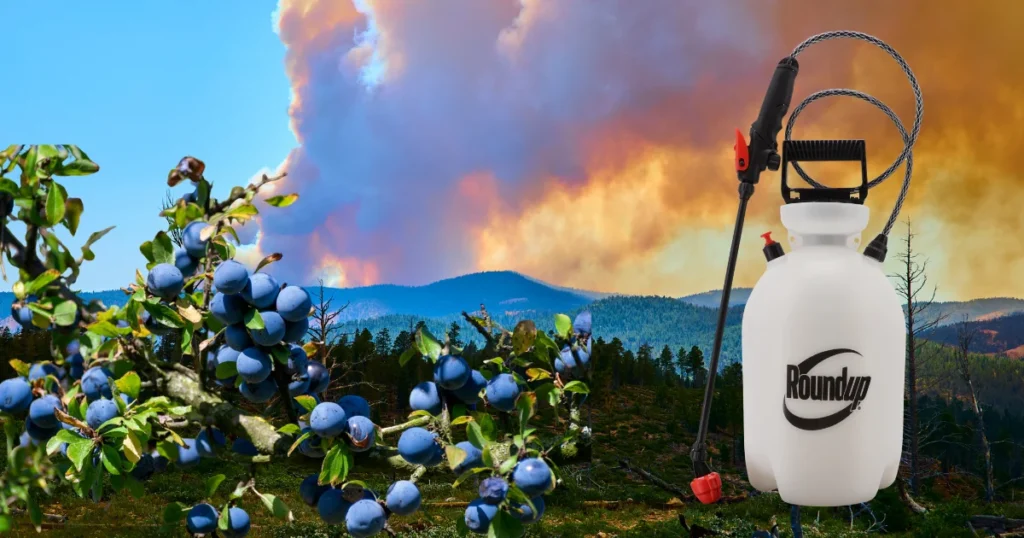
As thick plumes of wildfire smoke continue to blanket vast corridors of North America, originating from more than 800 active fires across Canadian provinces and dozens of uncontained blazes in northern Minnesota, a growing debate is emerging over the role of industrial forestry practices in exacerbating these seasonal catastrophes. While public discourse regarding glyphosate—the world’s most widely used herbicide—traditionally centers on agricultural runoff, food safety, and human carcinogenicity, environmental scientists and community advocates are increasingly pointing toward its intensive use in forest management as a hidden driver of both ecological instability and fire volatility.
Across the continent, thousands of hectares of public forest land are treated annually with glyphosate-based herbicides, often through aerial application. These operations target "non-commercial" vegetation to prioritize the growth of timber-heavy conifer species. However, recent data and investigative reports suggest that this practice is systematically dismantling the natural fire-suppression mechanisms of the North American wilderness, creating more uniform, highly flammable landscapes that threaten clean water supplies, wildlife habitats, and the cultural practices of Indigenous communities.
The Mechanization of Flammable Forests
The primary objective of glyphosate application in forestry is the elimination of broadleaf species such as birch, poplar, and aspen, as well as various berry-producing shrubs. These species compete for sunlight and soil nutrients with commercially valuable conifers like spruce and pine. By eradicating deciduous competition, timber operators can accelerate the growth cycle of harvestable wood.

However, ecologists warn that this "uniformity" comes at a significant cost to forest resilience. Deciduous trees, particularly aspen and birch, act as natural firebreaks. These species possess higher moisture content in their leaves and bark, which slows the spread of flames and keeps fires lower to the ground. In a diverse forest, these "green belts" provide critical windows for firefighters to establish containment lines.
When these natural buffers are removed via chemical thinning, they are replaced by dense stands of resinous conifers. Data indicates that when conifer-heavy forests burn, they release more than twice the carbon of comparable deciduous-rich forests. This creates a feedback loop: the increased carbon emissions contribute to the warming conditions that lengthen fire seasons, while the lack of broadleaf buffers allows fires to crown and spread with greater intensity. Furthermore, the dead vegetation left in the wake of glyphosate spraying adds to the "fuel load," providing dry tinder that can ignite rapidly during periods of drought.

The Expansion of Chemical Use in the United States
Despite increasing scrutiny, the use of glyphosate in U.S. forests has reached historic levels. A comprehensive investigation by various media outlets and environmental monitors has revealed that the U.S. Forest Service, in partnership with private timber interests, has significantly increased spraying operations in both clear-cut and fire-damaged regions.
California serves as a primary case study for this trend. In 2023, the state applied approximately 266,000 pounds of glyphosate to its forest lands—a fivefold increase compared to the volume applied twenty years ago. This surge has made forestry the fastest-growing market for glyphosate in California, even as the state grapples with some of the most destructive wildfire seasons in its history.
The legal landscape surrounding these practices shifted dramatically on June 25, 2026. In a landmark 7-2 ruling, the U.S. Supreme Court favored the chemical giant Bayer (which acquired Monsanto in 2018), effectively shielding the company from state-level "failure-to-warn" claims. This decision resulted in the dismissal of approximately 100,000 pending cases brought by plaintiffs who alleged that glyphosate exposure caused non-Hodgkin lymphoma. The ruling was bolstered by an amicus brief from the federal government, which had previously designated glyphosate as a substance "critical to national defense" under the Defense Production Act, citing its necessity for domestic food and timber security.
The Canadian Context: Policy Loopholes and Grassroots Resistance
In Canada, the conflict over forestry spraying has centered on the province of Ontario, where a stark policy contradiction exists. In 2009, Ontario implemented a ban on the cosmetic use of pesticides to protect families and pets from unnecessary chemical exposure in urban environments. However, the forestry industry was granted an explicit exemption from this legislation.
This loophole allows for the aerial application of glyphosate over Crown forests—land that rural and Indigenous communities rely on for water, hunting, and traditional medicine. The opposition to this practice has been led by groups such as Stop the Spray Ontario, which gained momentum following reports of illness among those consuming wild game from treated areas. In one notable instance, a bush pilot and hunter, Joel Theriault, documented symptoms among his family and peers consistent with glyphosate overexposure after consuming a black bear harvested from a recently sprayed region.
The summer of 2025 marked a turning point for Canadian activism. A series of coordinated protests, led by Indigenous communities and environmental advocates, successfully halted planned aerial herbicide applications in three major Ontario forest districts. These communities argue that the spraying violates treaty rights by destroying the biodiversity essential for traditional ways of life.

The Industry Shift: From Glyphosate to Persistent Alternatives
As glyphosate faces increasing legal and social pressure, the timber industry has begun transitioning to alternative herbicides, specifically Triclopyr and Imazapyr. However, environmental toxicologists warn that these chemicals are not safer alternatives.
Triclopyr is known to be moderately to highly toxic to freshwater fish and aquatic plants. It can persist in the soil for over a year, and its breakdown products have shown a tendency to migrate into groundwater and surface water systems. Similarly, Imazapyr is highly mobile in soil and has been linked to the contamination of water sources following aerial applications. For Indigenous communities, the shift to these chemicals is particularly concerning, as they pose a direct threat to non-target "medicine plants" and food sources that are sensitive to spray drift.
The transition to these alternatives suggests that the fundamental strategy of "chemical silviculture"—the reliance on herbicides to manage forest composition—remains unchanged despite the mounting evidence of its ecological risks.
Scientific Integrity and the Retraction of 2025
The regulatory foundation for glyphosate use has also come under fire. In December 2025, a pivotal study that had been cited by global regulators for a quarter-century to justify the safety of glyphosate was officially retracted. The retraction followed an investigation revealing that the study had been ghostwritten by Monsanto employees and relied heavily on the company’s own unpublished, internal research rather than independent peer-reviewed data.
This revelation has prompted calls for a comprehensive re-evaluation of herbicide safety standards by the Environmental Protection Agency (EPA) in the U.S. and Health Canada. Critics argue that the current regulatory framework fails to account for the "synergistic effects" of herbicides when combined with the stressors of a changing climate and the increased frequency of mega-fires.
Chronology of Key Events
- 1990s: Growth of the "Millions Against Monsanto" campaign as glyphosate becomes the standard for North American weed control.
- 2001: Quebec becomes a leader in forest management by banning the use of glyphosate in public forests, proving that manual thinning and ecological management are viable alternatives.
- 2009: Ontario bans cosmetic pesticide use but exempts the forestry industry.
- 2017: Litigation begins in earnest as thousands of cancer patients sue Bayer/Monsanto over non-Hodgkin lymphoma links.
- 2023: California reaches a record high of 266,000 pounds of glyphosate applied to forest lands.
- Summer 2025: Indigenous-led protests in Ontario successfully block aerial spraying in several forest districts.
- December 2025: A foundational safety study for glyphosate is retracted due to evidence of industry ghostwriting.
- June 25, 2026: The U.S. Supreme Court rules 7-2 in favor of Bayer, limiting the ability of individuals to sue for failure-to-warn under state laws.
Analysis of Broader Implications
The persistence of glyphosate use in forestry represents a clash between short-term economic efficiency and long-term ecological stability. From a timber production standpoint, herbicides are a cost-effective tool for maximizing yield. However, the externalized costs—increased wildfire suppression expenses, the destruction of carbon sinks, and the contamination of rural water supplies—are borne by the public.

The Quebec model provides a potential path forward. For 25 years, the province has managed its public forests without glyphosate, relying instead on manual brush cutting and selective harvesting. While more labor-intensive, this approach creates jobs and maintains a diverse forest structure that is naturally more resistant to fire.
As state legislatures in the U.S. begin to introduce bills aimed at restricting glyphosate in the wake of the Supreme Court’s decision, the focus is shifting from the courtroom to the capital. At least a dozen states have already proposed legislation to close the loopholes that allow for intensive forest spraying.
For the millions of people currently breathing the smoke of a burning continent, the question of how forests are managed is no longer an abstract policy debate. It is a matter of public health and regional safety. The ongoing reliance on chemical thinning may be simplifying the forest, but it is making the challenge of living alongside it increasingly complex and dangerous.