

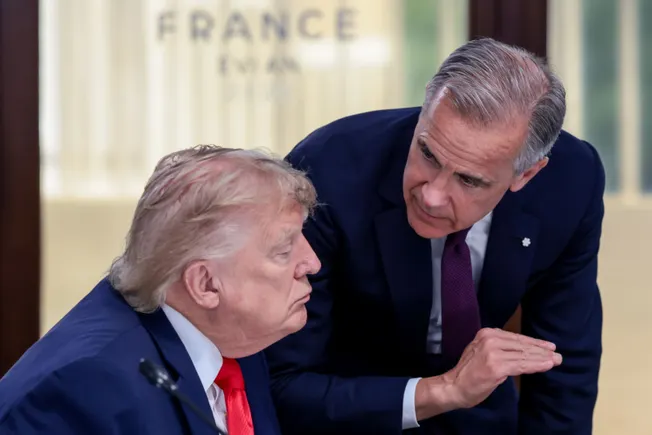
The economic partnership between the United States and Canada, long considered one of the most stable and productive bilateral relationships in the world, entered a period of profound uncertainty this Friday as high-stakes negotiations in Washington failed to avert the implementation of massive 50% tariffs. The collapse of the talks marks a significant escalation in a trade dispute that has simmered for over a month, following President Donald Trump’s executive order targeting $20 billion worth of Canadian imports. With both nations now retreating to protectionist stances, the immediate implementation of these levies threatens to disrupt integrated supply chains, increase costs for North American consumers, and fundamentally reshape the geopolitical landscape of the continent.
The breakdown in communication occurred after four weeks of intensive deliberations aimed at softening the blow of the tariffs, which cover a vast array of goods including raw agricultural products, natural materials, chemicals, textiles, consumer goods, wood products, paper, machinery, and industrial tools. Despite early signals of potential compromise, the negotiations disintegrated late Friday evening, leading Canadian Prime Minister Mark Carney to take the extraordinary step of suspending trade talks and recalling his negotiating team to Ottawa.
The Breakdown of Friday’s Negotiations
The collapse of the discussions was characterized by a sharp exchange of accusations from both sides, reflecting a deep-seated lack of trust between the two administrations. In an official statement released late Friday, Prime Minister Mark Carney expressed deep disappointment in the trajectory of the talks. While acknowledging that "important progress" had been made in recent weeks toward securing a favorable position for Canada, he asserted that the final proposals put forward by the United States were untenable.
"That progress has not been enough to meet our objectives for Canadians," Carney stated. He specifically pointed toward "last-minute changes" proposed by U.S. negotiators, describing them as "unfair, uneconomic, and calling into question the reliability of any deal." According to sources close to the Canadian delegation, these changes reportedly involved stringent new requirements for domestic content and labor standards that Ottawa viewed as a violation of previous understandings.
The Office of the United States Trade Representative (USTR) offered a starkly different interpretation of the events. In a statement posted on the social media platform X, the USTR blamed Canada for the impasse, claiming that the U.S. had offered "significant tariff reductions" on key commodities such as steel, aluminum, automobiles, and lumber. The U.S. position is that Canada introduced "new demands and walk backs of other commitments," which effectively "upended the careful balance" that negotiators had spent days constructing. The U.S. maintains that its offer would have granted Canada the "best treatment of any major exporter" to the American market, an offer they claim was rejected in favor of Canadian protectionism.
A Chronology of Escalation
The current trade war did not emerge in a vacuum; it is the culmination of a series of policy shifts and failed diplomatic overtures that began earlier this year. To understand the gravity of the current situation, it is necessary to examine the timeline of the deteriorating relationship:
- July 2026: The United States officially declines to extend the United States-Mexico-Canada Agreement (USMCA) in its current form. This decision triggered a mandatory up-to-10-year annual review process, effectively placing the future of the trilateral free trade zone in a state of permanent negotiation.
- Late July 2026: While Mexico and the U.S. begin formal bilateral discussions to stabilize their trade relationship, Canada finds itself increasingly sidelined. U.S. officials express dissatisfaction with Canada’s dairy supply management system and digital services taxes.
- August 2026: President Trump issues an executive order calling for 50% tariffs on $20 billion worth of Canadian imports. The administration cites the need to protect American manufacturing and address trade imbalances.
- Mid-August 2026: Negotiations begin in Washington. The U.S. temporarily delays the implementation of the tariffs as a gesture of good faith, while Prime Minister Carney’s government attempts to leverage Canada’s role as a primary supplier of energy and raw materials.
- August 21, 2026 (Friday): Negotiations officially collapse. Prime Minister Carney suspends talks and the 50% U.S. tariffs go into immediate effect.
- August 22, 2026 (Saturday): In a televised address, Prime Minister Carney announces that Canada will retaliate "dollar for dollar" and sets an effective date for counter-tariffs.
Canada’s Retaliatory Strategy
Following the return of his negotiators to Ottawa, Prime Minister Carney delivered a forceful speech on Saturday, outlining Canada’s defensive economic strategy. He confirmed that Canada would not only match the U.S. tariffs in monetary value but would also introduce additional measures to protect domestic industries from the resulting economic shock.
The Canadian retaliatory tariffs are scheduled to go into effect on September 8. While the specific duty rates for each category have yet to be finalized in the official regulatory registry, Carney identified the sectors that will bear the brunt of the measures. These include:
- Steel and Aluminum: Replicating previous trade skirmishes, Canada will target U.S. metals to protect its own smelting and manufacturing sectors.
- Dairy and Agriculture: A perennial point of contention, Canada intends to levy duties on U.S. agricultural exports, which could hit farmers in the American Midwest particularly hard.
- Appliances and Electronics: By targeting consumer goods, Ottawa aims to create domestic pressure within the U.S. as prices for household items rise.
- Pulp, Paper, and Agricultural Equipment: These sectors represent significant U.S. exports to the Canadian market, and tariffs here are designed to maximize economic friction.
"We will protect our workers and our industries," Carney said. "If the United States chooses to impose costs on Canadian businesses, we have no choice but to ensure there are reciprocal consequences."
Economic Data and Supply Chain Implications
The sheer scale of the $20 billion tariff package is expected to send shockwaves through the North American supply chain. Economists warn that because the U.S. and Canadian economies are so deeply integrated, these tariffs act as a tax on production that will eventually be passed down to consumers in both nations.
For the United States, the 50% levies on Canadian wood products and paper could lead to a sharp increase in construction costs. Canada is the largest foreign supplier of softwood lumber to the U.S., a critical component in residential home building. Similarly, tariffs on Canadian machinery and chemicals could raise the overhead for U.S. manufacturers who rely on Canadian inputs to produce finished goods.
For Canada, the retaliatory measures on electronics and agricultural equipment could hamper the productivity of its own farming and tech sectors. According to data from the Peterson Institute for International Economics, nearly 60% of U.S.-Canada trade consists of "intermediate goods"—products used to make other products. This means that a tariff on a Canadian chemical export can result in a price hike for an American-made consumer plastic, which might then be exported back to Canada, creating a feedback loop of inflation.
Industry Reaction and Expert Analysis
The business community on both sides of the border has expressed alarm at the breakdown of the talks. Trade associations representing the automotive and aerospace industries—sectors where parts often cross the border multiple times during the assembly process—have called for an immediate return to the negotiating table.
Pete Mento, managing director of global trade advisory services at Baker Tilly, provided a sober assessment of the situation in a recent analysis. While he remains optimistic that a deal will eventually be reached due to the sheer necessity of economic integration, he highlighted a more fundamental concern regarding the stability of international trade law.
"I still expect the United States and Canada to reach an agreement. Their economies are simply too integrated for prolonged escalation to be attractive to either side," Mento noted. "But the real question isn’t whether these particular tariffs survive. It is whether the eventual settlement restores confidence in the rules governing North American trade."
Mento’s observation underscores a growing fear among trade analysts: that the era of predictable, rules-based trade under the original NAFTA and the subsequent USMCA is giving way to a more volatile, "might-makes-right" era of bilateral brinkmanship.
The Path Forward and the Future of USMCA
The failure of these talks adds a significant hurdle to the ongoing review of the USMCA. While Mexico and the U.S. appear to be making progress on a bilateral basis, Canada now finds itself in a confrontational posture with its largest trading partner. The "sunset clause" and the annual review process established after the U.S. declined the extension last month mean that the entire framework of North American trade is currently on life support.
As the September 8 deadline for Canadian retaliation approaches, diplomatic channels remain theoretically open, but the rhetoric from both Washington and Ottawa suggests a hardening of positions. The U.S. administration appears committed to its "America First" trade policy, using high tariffs as leverage to extract concessions. Conversely, the Carney government seems determined to prove that Canada cannot be bullied into an "uneconomic" agreement.
The coming weeks will be a trial for the resilience of the North American economy. If a resolution is not found before the retaliatory measures take effect, the cost of living for millions of citizens across the continent is likely to rise, and the once-seamless border between these two economic giants may become a permanent barrier to prosperity. For now, the "best deal in the world" that Prime Minister Carney hoped for remains elusive, replaced by a trade war that neither side can truly afford to win.
