


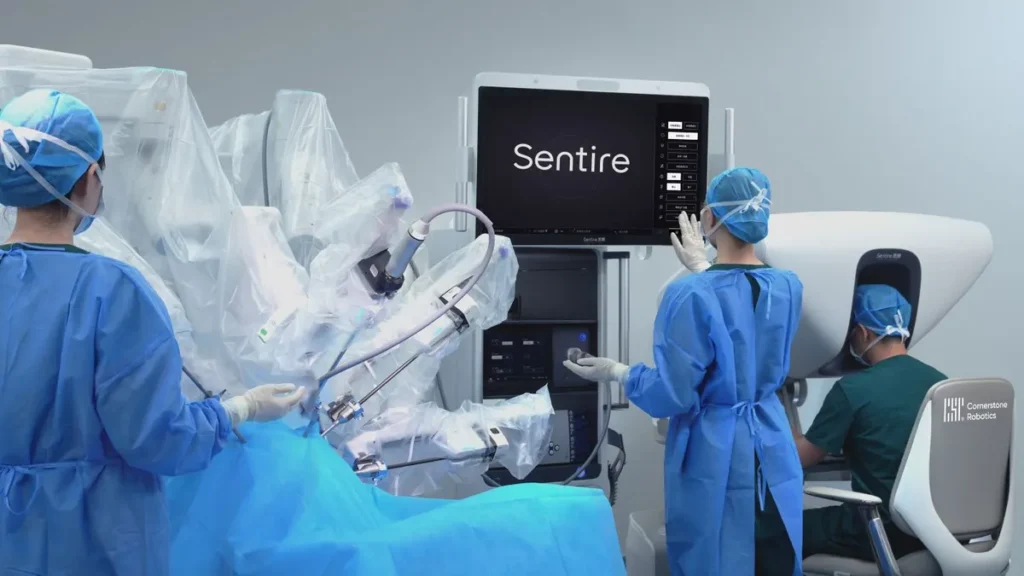
In a significant move to solidify its presence in the rapidly evolving field of digital surgery, Medtronic has entered into a strategic partnership with Hong Kong-based Cornerstone Robotics. Under the terms of the agreement, Medtronic will secure the rights to distribute Cornerstone’s Sentire surgical robot in select international markets outside of the United States. This partnership is designed to complement Medtronic’s proprietary Hugo robotic-assisted surgery (RAS) system, providing a multi-tiered approach to the global surgical market. The collaboration highlights a growing trend among medical technology giants to diversify their portfolios through strategic alliances, ensuring they can meet varying clinical needs and economic constraints across diverse geographic regions.
The announcement comes at a pivotal time for Medtronic, which has been aggressively scaling its robotic capabilities to challenge the long-standing dominance of Intuitive Surgical’s da Vinci system. By integrating the Sentire system into its commercial channel, Medtronic aims to offer healthcare providers a broader spectrum of choices, ranging from high-end modular platforms to systems tailored for specific procedural or economic environments. The Sentire system, which received regulatory approval from China’s National Medical Products Administration (NMPA) earlier in 2024, is noted for its precision, modular design, and ergonomic interface, making it a competitive entry in the soft-tissue robotic space.
Strategic Synergy and Market Positioning
Medtronic’s decision to partner with Cornerstone Robotics is rooted in a "complementary" strategy. During a recent earnings call, Medtronic CEO Geoff Martha addressed potential concerns regarding whether this move signaled a lack of confidence in the company’s internal Hugo system. Martha clarified that the investment is actually an indicator of the company’s bullish outlook on the sector. He emphasized that the robotic surgery market is currently underserved, with global penetration still in the single digits. In emerging markets, that figure drops to a mere 1%, representing a massive "runway" for growth that no single system can fully capture alone.

The Sentire system is expected to serve as a versatile tool that allows Medtronic to compete in market segments where the Hugo system might not be the primary choice due to cost, hospital infrastructure, or specific surgical preferences. While Hugo is Medtronic’s flagship "premium" offering—boasting modularity and integrated digital ecosystems—the Sentire system provides an alternative that may better suit certain economic models in developing healthcare systems or smaller surgical centers. This dual-track strategy mirrors practices in other high-tech industries, where companies offer a range of products to capture different tiers of the consumer base.
A Chronology of Medtronic’s Robotic Ambitions
Medtronic’s journey into soft-tissue robotics has been a multi-year endeavor marked by significant regulatory milestones and technical hurdles. The development of the Hugo system was intended to break the monopoly held by Intuitive Surgical for over two decades.
- October 2021: Medtronic received the CE Mark for the Hugo RAS system, allowing its sale in the European Union for urologic and gynecologic procedures.
- 2022-2023: The company focused on a "limited market release," gathering clinical data and refining the user interface based on surgeon feedback. During this period, Hugo was introduced to markets in Latin America, Asia-Pacific, and Canada.
- Late 2023: Medtronic achieved a major milestone by receiving U.S. Food and Drug Administration (FDA) clearance for Hugo in urologic procedures. This officially introduced a major competitor to the da Vinci system in the world’s largest healthcare market.
- July 2024: Competition intensified as Johnson & Johnson’s MedTech division received FDA authorization for its Ottava robotic system, signaling a "three-way war" for the future of the operating room.
- August 2024: Medtronic announced the distribution deal with Cornerstone Robotics and confirmed the submission of 510(k) filings to the FDA to expand Hugo’s indications to include general surgery and gynecology in the U.S.
The addition of the Sentire system to Medtronic’s international catalog is the latest chapter in this timeline, representing a shift from purely internal development to a hybrid model of innovation and strategic acquisition/distribution.
Technical Profiles: Hugo vs. Sentire
To understand the value of the partnership, it is essential to look at the technical specifications of the systems involved. Medtronic’s Hugo system is characterized by its four independent instrument towers, which can be moved between operating rooms, providing flexibility that fixed-base systems lack. It also features a high-definition 3D vision system and a dedicated "Touch Surgery" digital platform that uses artificial intelligence to analyze surgical videos for training and quality improvement.
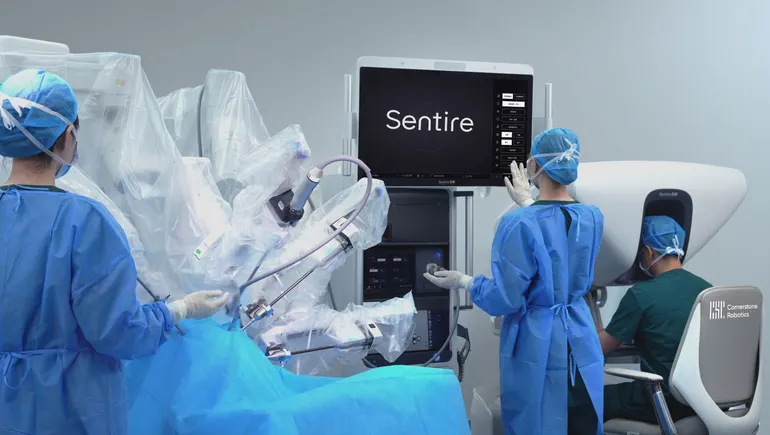
Cornerstone Robotics’ Sentire system shares some of these modern characteristics but brings its own unique advantages. Developed at the Hong Kong Science Park by a team led by Dr. Samuel Au—a former research dean and an engineer with previous experience at Intuitive Surgical—the Sentire system was built with a focus on high-fidelity haptic feedback and an intuitive control console. Its recent approval in China was based on clinical trials demonstrating its efficacy in complex abdominal and thoracic procedures. By leveraging Cornerstone’s regional expertise and engineering, Medtronic can bypass the long lead times required to develop a secondary "value-tier" system from scratch.
Data and Market Dynamics
The financial stakes in the robotic-assisted surgery market are immense. Industry analysts estimate the global RAS market will grow at a compound annual growth rate (CAGR) of 10% to 15% over the next decade, potentially reaching a valuation of $15 billion to $20 billion by 2030. Despite this, the barriers to entry remain high. A single robotic system can cost between $1 million and $2.5 million, with annual maintenance contracts and per-procedure instrument costs adding significant financial pressure on hospitals.
Medtronic reported that the Hugo system is currently available in 35 countries. The company has seen procedure growth at more than twice the rate of the general robotic surgery market. Medtronic expects to have 250 Hugo units installed globally by the end of its current fiscal year, with total cumulative procedures projected to surpass 50,000.
However, the "single-digit" penetration cited by Martha remains the most telling statistic. Most surgeries worldwide—including gallbladder removals, hernia repairs, and hysterectomies—are still performed via traditional laparoscopy or open surgery. The primary obstacles to adoption are cost and the steep learning curve for surgeons. By offering both Hugo and Sentire, Medtronic is positioning itself to lower these barriers, providing options that fit different hospital budgets while maintaining a standardized level of support and training through Medtronic’s global service network.
Reactions and Industry Implications
The partnership has drawn mixed reactions from market analysts. Some view it as a savvy move to block competitors like CMR Surgical (makers of the Versius robot) and Moon Surgical from gaining a foothold in emerging markets. By controlling the distribution of a high-quality system like Sentire, Medtronic effectively occupies more "shelf space" in the global surgical market.
Others, however, question the complexity of supporting two different robotic architectures. Maintaining separate supply chains for instruments, different training protocols for surgeons, and distinct software updates could prove logistically challenging. Medtronic has countered this by stating that its global scale allows it to manage such complexities more efficiently than smaller startups.

From a broader perspective, this deal highlights the growing influence of the Greater Bay Area (Hong Kong-Shenzhen-Guangzhou) as a hub for medical robotics. Cornerstone Robotics represents a new wave of Chinese medtech companies that are moving beyond "copycat" technology to develop original, high-spec hardware capable of meeting international standards.
The Role of AI and Digital Ecosystems
A critical component of Medtronic’s strategy, which will likely extend to its distribution of the Sentire system, is the integration of Artificial Intelligence. Recently, Medtronic gained FDA clearance for an AI-powered application designed to support real-time decision-making during robotic procedures. This "digital surgery" approach transforms the robot from a mechanical tool into an intelligent assistant.
By bringing Sentire into its fold, Medtronic may eventually integrate its own digital and AI tools—such as the Touch Surgery platform—with the Cornerstone hardware. This would create a unified "Medtronic Experience" for surgeons, regardless of whether they are using the Hugo or Sentire console. The goal is to create a "locked-in" ecosystem where the data generated during surgery becomes as valuable as the hardware itself.
Future Outlook
Looking ahead, Medtronic’s dual-robot strategy will be tested by the upcoming commercial launches of competitive systems from Johnson & Johnson and the continued evolution of Intuitive Surgical’s da Vinci 5. The success of the Cornerstone partnership will depend on how effectively Medtronic can segment the market. If Sentire is positioned successfully as a high-performance, cost-effective alternative in regions like Southeast Asia, the Middle East, and parts of Europe, it could provide the volume Medtronic needs to sustain its massive R&D investments in the sector.
As surgical robotics moves from a niche luxury to a standard of care, the battle will be won not just by the most advanced robot, but by the company that offers the most flexible, integrated, and economically viable solution. With the addition of the Sentire system, Medtronic has signaled that it intends to be that company, leveraging both its internal innovation and strategic global partnerships to define the next era of surgery.