

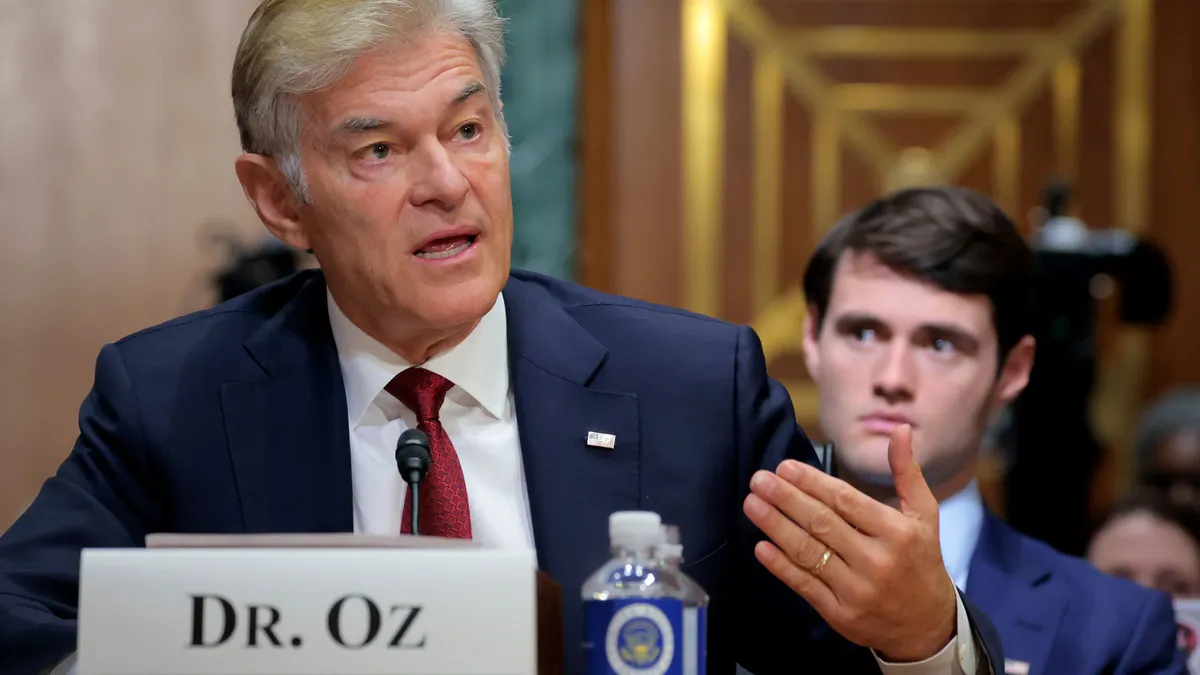
Dr. Mehmet Oz, the Administrator for the Centers for Medicare and Medicaid Services (CMS), issued a stark warning this week regarding the immediate financial impact of artificial intelligence on the American healthcare system. Speaking at Oracle’s annual health and life sciences summit in Orlando, Florida, Oz characterized the current integration of AI into medical billing as an "inflationary" force that will "turbocharge" the ability of providers to extract payments from the system. While acknowledging the short-term pain of rising costs, the CMS head maintained that the technology is an absolute necessity for the future of clinical medicine and eventual long-term fiscal sustainability.
The comments come at a pivotal moment for the Trump administration as it seeks to balance a pro-innovation, deregulatory agenda with the practical necessity of controlling federal spending on Medicare and Medicaid. Oz’s assessment reflects a growing consensus among industry analysts that while AI promises to streamline administrative burdens, its first widespread application—automated medical coding—is acting as a powerful engine for revenue maximization rather than cost reduction.
The Short-Term Inflationary Surge in Medical Billing
The core of Dr. Oz’s concern lies in the "administrative arms race" currently unfolding between healthcare providers and insurers. For decades, medical billing has been a labor-intensive process prone to human error and oversight. AI-powered coding tools, however, can scan thousands of pages of clinical notes in seconds, identifying every possible reimbursable condition, secondary diagnosis, and procedural nuance that a human coder might miss.
"Short term, AI is going to be inflationary because it’s going to turbocharge the ability of the current billing systems to work more effectively," Oz stated during his Wednesday address. This "effectiveness" translates directly into higher billable amounts for hospitals and physician groups. By ensuring that every patient encounter is coded to the maximum allowable level of complexity—a practice often referred to as "optimization" by providers and "upcoding" by critics—AI is effectively increasing the per-patient cost of care without necessarily changing the underlying medical services provided.
Supporting this assessment is a comprehensive analysis released Thursday by the Blue Cross Blue Shield Association (BCBSA). The study found that the rapid adoption of AI-driven coding tools has added nearly $1 billion to US healthcare costs between 2023 and 2025. The BCBSA report raised significant concerns that these tools are contributing to systemic spending increases, as the technology allows providers to capture more "acuity" in their patient populations, which in turn triggers higher risk-adjusted payments from both private insurers and the federal government.
The Shift from Administrative Efficiency to Clinical Necessity
Despite the warnings regarding cost, Dr. Oz framed the adoption of AI as a moral and clinical imperative. He pushed back against the notion that the government should stifle AI development to save money, arguing that the technology’s role in "day-to-day trench warfare" against disease is indispensable.
"I guarantee you we will lose lives if we don’t use AI in the day-to-day trench warfare of fighting disease in America," Oz told the summit audience. This sentiment aligns with the broader goals of the CMS to utilize predictive analytics for early disease detection, personalized treatment plans, and the reduction of medical errors. The administration’s perspective suggests that the initial "inflationary" period is a necessary investment to modernize a legacy system that is currently struggling with clinician burnout and inefficient data management.
The CMS has already taken structural steps to institutionalize this focus. In June, the agency established the Office of Health Technology Products and AI. This new office is tasked with overseeing the implementation of AI across the Medicare and Medicaid ecosystems, with a dual mandate: fostering innovation that improves patient outcomes while simultaneously developing sophisticated anti-fraud tools to combat the very billing inflation Oz described.
Accountable Care Organizations as a Fiscal Safeguard
To mitigate the inflationary risks of AI in a fee-for-service environment, Dr. Oz pointed toward Accountable Care Organizations (ACOs) as the primary solution. ACOs are groups of doctors, hospitals, and other healthcare providers who come together voluntarily to give coordinated high-quality care to their Medicare patients. The goal of coordinated care is to ensure that patients, especially the chronically ill, get the right care at the right time, while avoiding unnecessary duplication of services and preventing medical errors.

In the ACO model, providers are rewarded for health outcomes and cost savings rather than the volume of services billed. Oz argued that by shifting the industry away from the traditional fee-for-service model—where AI acts as a "billing engine"—toward value-based care, the incentives for AI usage will shift. In a value-based system, providers would use AI to identify high-risk patients earlier, reduce hospital readmissions, and streamline workflows to lower overhead, rather than simply finding more codes to bill.
The CMS has recently launched several initiatives to boost ACO participation, claiming that these models have already saved Medicare billions of dollars. However, the transition is not without its detractors. Critics of the ACO model argue that it places undue financial risk on smaller provider practices and adds layers of bureaucratic reporting that can distract from patient care. Nevertheless, for the current CMS leadership, the ACO framework is viewed as the essential "guardrail" that will eventually turn AI from a cost-driver into a cost-saver.
Chronology of Federal AI Integration in Healthcare
The current focus on AI at the CMS is the result of a multi-year acceleration of technology policy. While AI has been a topic of discussion for over a decade, the timeline of its recent integration into federal policy highlights the urgency of the current administration’s approach:
- June 2024: CMS formally creates the Office of Health Technology Products and AI to centralize the agency’s response to emerging technologies.
- Late 2024: The Trump administration signals a rollback of certain AI regulations, favoring a "light-touch" approach to encourage domestic tech competition.
- January 2025: CMS incorporates AI-driven "health tech ecosystem" initiatives into its strategic plan, focusing on interoperability and data sharing between providers.
- March 2025: Dr. Mehmet Oz, during his confirmation process and subsequent public appearances, identifies AI-driven billing inflation as a primary short-term challenge for the Medicare Trust Fund.
- March 14, 2025: Oz testifies before the Senate Finance Committee, emphasizing the need for AI in clinical settings while acknowledging the risks of automated "upcoding."
Broader Implications for the Healthcare Industry
The "turbocharged" billing environment described by Dr. Oz has significant implications for various stakeholders across the healthcare continuum.
For private insurers, the rise of AI-powered coding necessitates an equal and opposite investment in AI-powered claims auditing. This creates a technological "arms race" where payers use AI to detect "anomalous" billing patterns generated by the providers’ AI. The result is an increase in administrative costs for both parties, which is often passed down to employers and individual policyholders in the form of higher premiums.
For patients, the impact is twofold. On one hand, AI integration in the clinical space could lead to faster diagnoses and more precise treatments. On the other hand, if AI-driven billing leads to higher "acuity" scores for their visits, patients with high-deductible plans may see an increase in their out-of-pocket costs for the same level of care they received in previous years.
For the federal government, the challenge is one of solvency. Medicare spending is a massive portion of the federal budget, and any technology that "turbocharges" the extraction of funds from the Medicare Trust Fund is a matter of national economic security. The administration’s bet is that by leaning into ACOs and value-based care, they can pivot the industry before the inflationary effects of AI become unmanageable.
Conclusion: A Precarious Path Toward Efficiency
Dr. Oz’s candid assessment serves as a reality check for the "AI hype" that has dominated the healthcare sector over the last twenty-four months. By acknowledging that things will "get worse before they get better," the CMS Administrator is attempting to manage expectations while setting the stage for a broader structural overhaul of how healthcare is paid for in America.
The success of this strategy depends entirely on the speed at which the industry can transition from fee-for-service to value-based models. If the "turbocharged" billing systems of today are allowed to operate within the traditional payment framework for too long, the resulting inflation could jeopardize the financial stability of the nation’s largest healthcare programs. However, if the CMS can successfully leverage AI for clinical "trench warfare" while using ACOs to neutralize billing incentives, the long-term savings and improvements in human life that Oz envisions may eventually be realized. For now, the healthcare industry remains in a period of volatile transition, where the very tools designed to save it are currently making it more expensive.
