

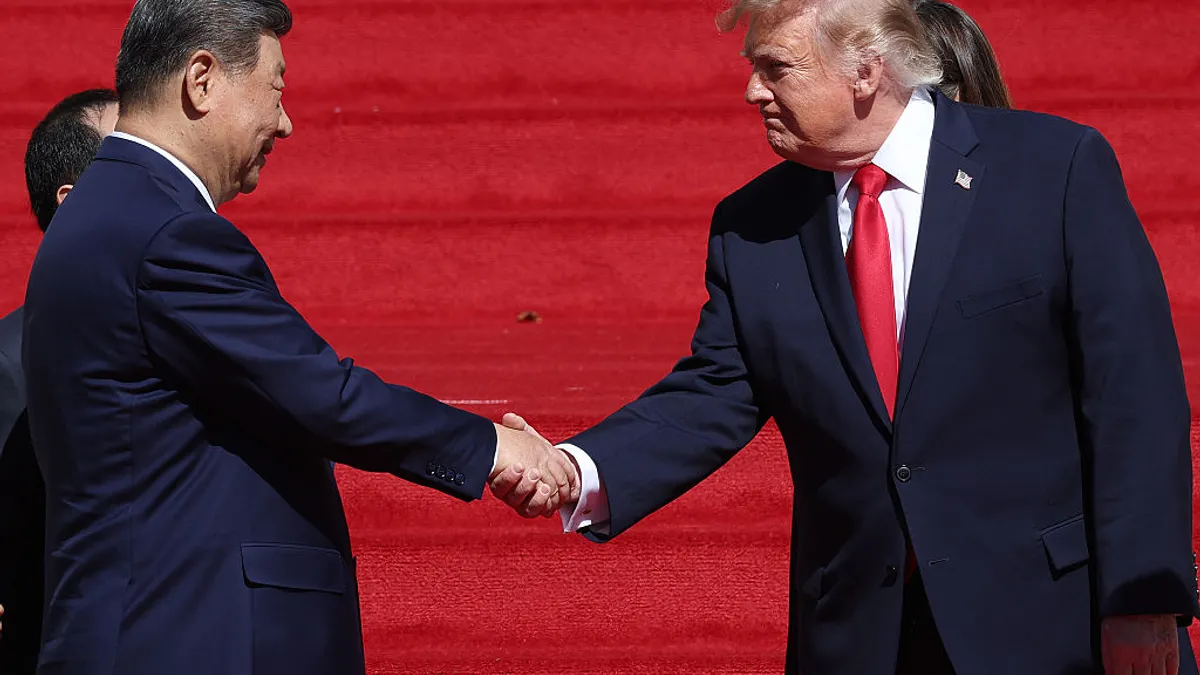
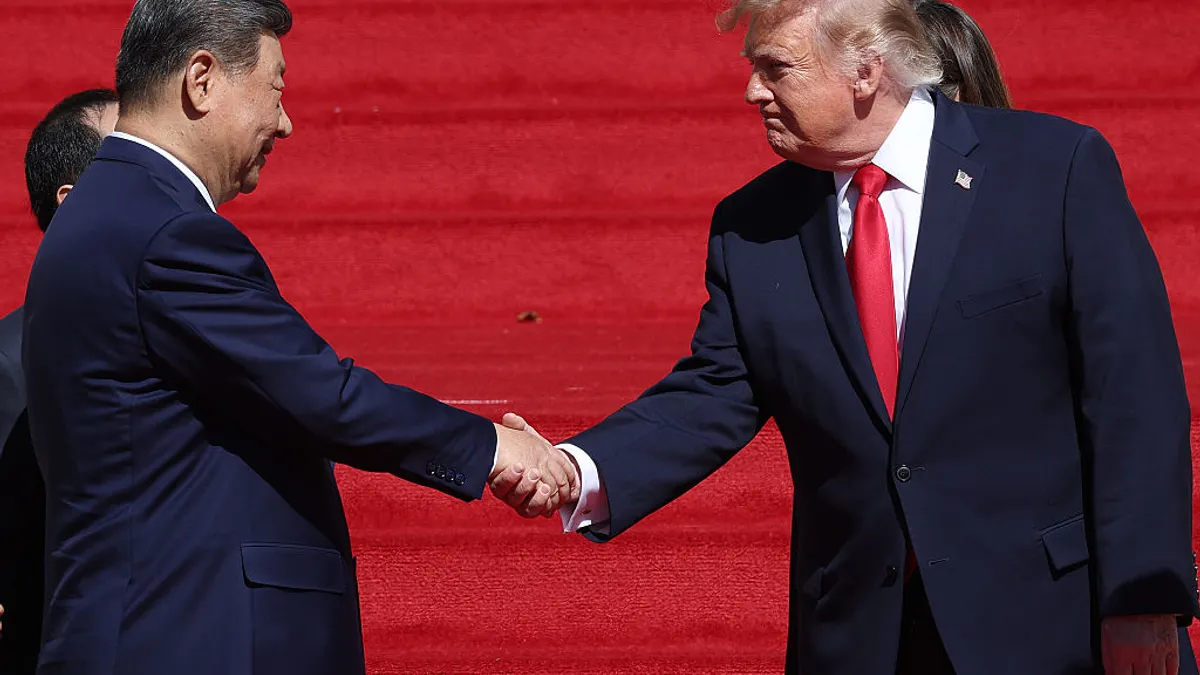
The Trump administration announced on Sunday that the newly established U.S.-China Board of Trade has recommended a significant de-escalation in trade tensions, proposing reduced tariff treatment for "non-sensitive" goods totaling approximately $30 billion in imports for each nation. This $60 billion reciprocal framework, emerging just days after a historic state visit by Chinese President Xi Jinping to Washington, D.C., represents the most concrete step toward a formal trade realignment since the two economic superpowers agreed to a temporary truce earlier this year.
The recommendations, detailed in a series of White House releases, target specific sectors intended to provide mutual economic relief without compromising national security or strategic industrial interests. According to U.S. Trade Representative Jamieson Greer, the proposal focuses on unlocking market access for roughly 30 percent of U.S. exports to China, particularly in the agricultural and medical device sectors. In exchange, the United States would lower duties on Chinese-made household goods, toys, and various consumer products—categories where the U.S. lacks significant domestic manufacturing capacity and relies heavily on Chinese supply chains.
“From agricultural products to medical devices, President Trump is unlocking improved market access for about 30 percent of U.S. exports to China,” Ambassador Greer said in an official statement. “Simultaneously, this will benefit American consumers by lowering the cost of imports from China for household goods, toys, and other products that the United States generally does not import from other countries.”
Chronology of the 2026 Trade Realignment
The path to Sunday’s announcement began in early 2026, following a period of renewed volatility in trans-Pacific trade relations. The establishment of the U.S.-China Board of Trade was first announced in May 2026, envisioned as a permanent consultative body designed to bypass the ad-hoc "trade war" cycles of previous years. The board was tasked with identifying "low-hanging fruit"—goods that could be traded more freely to stimulate economic growth without touching sensitive technologies like semiconductors or advanced telecommunications.
In late August 2026, as a previous trade truce neared its expiration, both Beijing and Washington agreed to a two-month extension, pushing the deadline to January 2027. This extension provided the necessary diplomatic breathing room for President Xi Jinping’s visit to the National Archives Museum and the White House last week. The summit between President Trump and President Xi was characterized by officials as "constructive and pragmatic," focusing heavily on the "30-for-30" framework—a reference to the $30 billion in reciprocal tariff cuts.
The timeline leading to this proposal includes several key milestones:
- May 2026: Formal creation of the U.S.-China Board of Trade.
- July 2026: Initial deputy-level meetings in Zurich to define "non-sensitive" goods.
- September 22-25, 2026: President Xi Jinping’s state visit to Washington.
- September 27, 2026: Official extension of the trade truce through early 2027.
- September 30, 2026: Release of the "30-for-30" framework and specific product lists.
Structural Mechanics of the U.S.-China Board of Trade
The Board of Trade is not merely a diplomatic forum but a structured administrative body. It is led by a triumvirate of high-ranking officials: U.S. Trade Representative Jamieson Greer, U.S. Treasury Secretary Scott Bessent, and China’s Vice Premier of the State Council, He Lifeng. The board’s mission, according to its working procedures document, is to "optimize bilateral trade" through data-driven assessments and regular policy adjustments.
Beneath the lead officials, a secondary layer of deputies is tasked with the day-to-day monitoring of trade flows. These deputies are empowered to submit proposals for further tariff adjustments based on market performance. The Sunday announcement clarified that the "30-for-30" framework is intended to be a baseline. If the initial reductions result in stable market conditions and compliance with intellectual property standards, the board has the authority to expand the list of covered items.
The "Terms of Reference" document released by the White House outlines a rigorous assessment process. Both sides will monitor trade volumes for the included products on a quarterly basis. If one side perceives an imbalance or a failure to meet purchase commitments, the "favorable tariff treatment" can be suspended, providing a "snap-back" mechanism that has been a hallmark of the Trump administration’s trade policy.

Sector-Specific Analysis and Market Impact
The list of products slated for tariff relief has been carefully curated to address specific economic pressures in both countries. For the United States, the focus on agricultural exports is a strategic move to bolster the "Farm Belt" economy. Products such as soybeans, corn, and pork are expected to see streamlined customs procedures and lower Chinese duties, providing a vital outlet for American farmers who have faced fluctuating demand over the past decade.
In the medical device sector, the inclusion of American-made diagnostic equipment and surgical tools aims to tap into China’s rapidly aging population and its expanding healthcare infrastructure. This move is seen as a win for high-tech U.S. manufacturing, which maintains a competitive edge in specialized medical technology.
Conversely, the U.S. concessions on household goods and toys are aimed directly at cooling domestic inflation. Retailers like Walmart, Target, and various "dollar store" chains have long lobbied for relief on these specific categories, noting that they are almost exclusively sourced from Chinese factories. By reducing tariffs on these items, the administration seeks to lower the cost of living for American families ahead of the 2026 holiday shopping season, even if the implementation dates remain unconfirmed.
However, the lack of a specific implementation timeline has drawn scrutiny from trade experts. Wendy Cutler, Senior Vice President at the Asia Society Policy Institute and a former veteran trade negotiator, noted that the White House documentation remains "vague" on when these changes will take effect.
"Both sides need to go through their domestic procedures," Cutler stated in a public analysis. "It remains unclear if the U.S. will seek public comments on the product list, which could delay the actual implementation for months. The way the document is written, it doesn’t seem to be very open to revisions, suggesting the administration may try to fast-track the process."

Legal Hurdles and Domestic Implementation
Before the proposed tariff cuts can be enacted, both the U.S. and China must navigate their respective legal frameworks. In the United States, this typically involves the Section 301 process of the Trade Act of 1974. While the President has significant authority to modify tariffs, the process usually requires a period of public notice and comment, during which domestic industries can argue for or against the inclusion of specific products.
Legal analysts suggest that the administration might utilize existing executive authorities to expedite the "30-for-30" framework, framing it as a modification of existing trade enforcement actions rather than a new treaty. In China, the process is expected to be more centralized, with the State Council’s Tariff Commission likely issuing a decree once the final technical details are settled with their American counterparts.
The "Terms of Reference" document explicitly states that the reductions "will be determined and implemented in accordance with each side’s domestic legal processes." This clause provides a safeguard for both governments but also introduces a layer of uncertainty for supply chain managers who need firm dates to plan inventory and pricing.
Broader Geopolitical and Economic Implications
The emergence of the Board of Trade and the "30-for-30" framework signals a shift in the U.S.-China relationship from one of pure confrontation to one of managed competition. By compartmentalizing "sensitive" goods (such as AI chips and quantum computing) away from "non-sensitive" consumer goods, the two nations are attempting to preserve the benefits of globalization while addressing national security concerns.
Economically, the move is expected to provide a modest boost to global GDP. Analysts at major financial institutions estimate that a successful implementation of these cuts could add 0.2% to 0.3% to the growth of both economies over the next two years. More importantly, it provides a "stability premium" for global markets, which have been rattled by the prospect of an all-out trade war.
However, critics of the plan argue that it does not address the underlying structural issues of the bilateral relationship, such as industrial subsidies and currency valuation. Furthermore, some domestic manufacturers in the U.S. have expressed concern that lowering tariffs on any Chinese goods—even "non-sensitive" ones—could further entrench reliance on overseas supply chains at a time when "near-shoring" and "friend-shoring" are being promoted.
Future Outlook
As the January 2027 deadline for the current trade truce approaches, all eyes will be on the Board of Trade’s next moves. The success of the "30-for-30" framework will likely serve as a litmus test for the future of the relationship. If the tariff reductions are implemented smoothly and trade volumes increase without significant friction, it could pave the way for a more comprehensive "Phase Two" agreement.
For now, the international business community remains cautiously optimistic. The announcement provides a roadmap for de-escalation, but the "vague" nature of the implementation timeline serves as a reminder that in the world of high-stakes trade diplomacy, the transition from proposal to policy is rarely instantaneous. Supply chain leaders are advised to monitor the Federal Register for upcoming public comment periods, which will provide the first clear indication of the actual effective dates for these proposed tariff reductions.
