

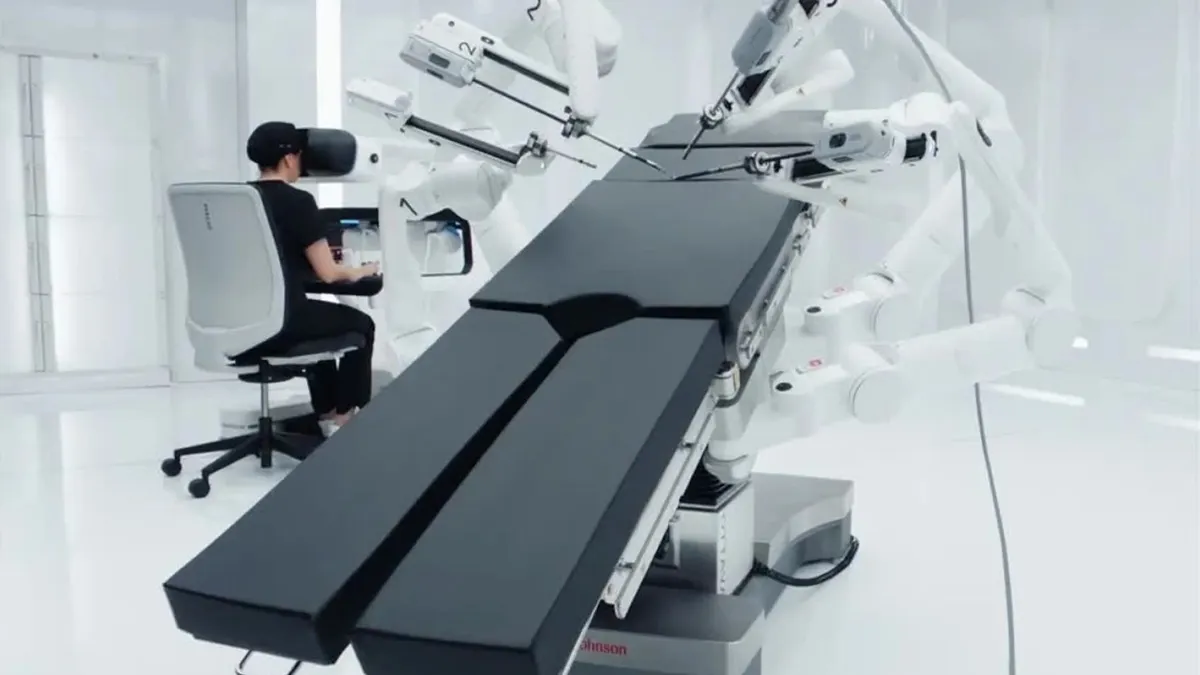
Johnson & Johnson has reached a pivotal milestone in its multi-year effort to challenge the dominance of the robotic surgery market, announcing that its Ottava soft tissue robotic surgical system has received de novo authorization from the U.S. Food and Drug Administration. The regulatory clearance positions the healthcare giant to compete directly with Intuitive Surgical, the long-standing market leader, while introducing a novel architectural approach to robotic-assisted surgery. By integrating robotic arms directly into the operating table, the Ottava system represents a departure from the traditional cart-based or boom-mounted configurations that have defined the industry for more than two decades.
The FDA’s authorization specifically covers the use of Ottava in general surgery. The approved indications include a wide range of common and complex procedures, such as Roux-en-Y gastric bypass, gastrectomy, cholecystectomy (gallbladder removal), splenectomy, gastric sleeve, small bowel resection, appendectomy, fundoplication, hiatal hernia repair, and the lysis of adhesions. This broad initial scope allows Johnson & Johnson to target high-volume surgical departments immediately upon the system’s commercial rollout.
A New Architectural Paradigm in the Operating Room
The central value proposition of the Ottava system lies in its physical footprint and integration. According to technical specifications provided by Johnson & Johnson, the system occupies 30% to 50% less space than traditional robotic systems. In the increasingly crowded environment of a modern operating suite, space is a premium commodity. By incorporating four robotic arms into the surgical table itself, Ottava eliminates the need for large, wheeled carts or ceiling-mounted booms that can obstruct the movement of surgical staff and anesthesia teams.
This "unified" design is intended to facilitate "multi-quadrant" surgery, where a surgeon may need to access different parts of the abdomen without repositioning the entire robotic setup. The system features synchronized movement between the operating table and the robotic arms, allowing the patient to be repositioned during a procedure while the robot maintains its alignment and surgical access. This capability is designed to streamline workflows and potentially reduce the overall duration of surgeries, an efficiency gain that hospitals closely monitor when calculating the return on investment for expensive medical capital equipment.
Tim Schmid, Executive Vice President and Worldwide Chairman of Johnson & Johnson MedTech, emphasized that the company is "pioneering a new category" of robotics. The launch is part of a broader strategy to leverage J&J’s massive existing footprint in surgical instruments. The Ottava system is designed to use the company’s Ethicon-branded instruments, which are already staples in operating rooms worldwide. This integration provides a level of familiarity for surgeons transitioning from manual laparoscopic surgery to robotic-assisted platforms.
The Long Road to Regulatory Clearance: A Chronology
The path to the FDA authorization of Ottava has been marked by significant investment, strategic acquisitions, and technical evolution. To understand the significance of this milestone, one must look at the timeline of Johnson & Johnson’s robotic ambitions:
- 2015: Johnson & Johnson forms Verb Surgical, a joint venture with Verily (a subsidiary of Alphabet/Google), with the goal of creating a "digital surgery" platform that combines robotics, advanced visualization, and data analytics.
- 2019: J&J acquires Auris Health for approximately $3.4 billion. This acquisition brought in the Monarch platform for lung bronchoscopy and, more importantly, the expertise of Dr. Fred Moll, a co-founder of Intuitive Surgical and a pioneer in the field.
- 2020: The company completes the full acquisition of Verb Surgical, bringing the joint venture entirely under the J&J MedTech umbrella.
- 2021: During an investor update, J&J reveals a delay in the Ottava timeline, pushing back the start of clinical trials due to technical refinements and the impact of the global pandemic on development cycles.
- 2023: Johnson & Johnson provides a major update on the Ottava design, showcasing the table-integrated arms and confirming that the system would finally head toward a formal FDA submission.
- May 2024: The company officially submits the Ottava system for FDA de novo authorization.
- November 2024: The FDA grants authorization, a relatively rapid six-month turnaround that suggests a robust data package and a clear regulatory pathway for the "new category" of device.
Market Context and the Competitive Moat of Intuitive Surgical
While the FDA approval is a clear victory for Johnson & Johnson, the company faces a formidable incumbent in Intuitive Surgical. Intuitive’s da Vinci system has enjoyed a near-monopoly in the soft-tissue robotic space for over 20 years. As of late 2024, Intuitive maintains an installed base of nearly 9,000 systems globally and recently launched its fifth-generation platform, the da Vinci 5.
The challenge for J&J is not just the hardware, but the ecosystem. Intuitive has trained tens of thousands of surgeons and established deep institutional roots in hospitals. Switching to a new platform requires significant retraining for both surgeons and nursing staff, as well as a shift in hospital procurement and maintenance contracts.
Wall Street analysts have expressed a mix of optimism and caution regarding J&J’s ability to seize market share. Robbie Marcus, an analyst at J.P. Morgan, noted that while Ottava’s smaller footprint and bedside integration are "interesting selling points," the system is unlikely to cause a material dent in Intuitive’s market share in the immediate future. Marcus suggested that Intuitive’s "moat"—built on two decades of clinical data, surgeon familiarity, and a vast library of specialized instruments—remains difficult to breach.
However, Stifel analyst Rick Wise offered a more nuanced view, highlighting that by securing approval, Johnson & Johnson is now officially "in the game." Wise pointed out that the quick six-month FDA turnaround was a positive signal and that J&J can now begin the iterative process of improving the system and expanding its indications. He noted that while the initial launch will likely be "deliberate and phased," the long-term potential for J&J to bundle Ottava with its other MedTech offerings (such as sutures, staplers, and energy devices) provides a competitive advantage that Intuitive does not possess.
Data Integration and the Digital Ecosystem
A key component of the Ottava system is its connectivity to the Polyphonic digital ecosystem. Modern surgery is increasingly data-driven, and J&J is positioning Ottava as a "connected" device. The system is designed to capture surgical data, which can then be used for video review, surgeon training, and hospital efficiency analytics.
The integration of artificial intelligence (AI) and machine learning is expected to play a role in the system’s evolution. By analyzing thousands of procedures, the platform could eventually offer real-time guidance to surgeons or help identify anatomical landmarks, reducing the risk of complications. Hani Abouhalka, Group Chair of MedTech Surgery at J&J, remarked that "what defined the last 25 years of surgery will not define the next 25," signaling the company’s belief that the future of the field lies in the intersection of physical robotics and digital intelligence.
Financial and Strategic Implications for Johnson & Johnson
For Johnson & Johnson, Ottava is more than just a new product; it is a critical component of its MedTech growth strategy. Following the spin-off of its consumer health division (Kenvue), J&J has doubled down on its high-growth MedTech and Pharmaceutical segments. The robotic surgery market is estimated to be worth approximately $18 billion annually and is projected to grow at a double-digit compound annual growth rate (CAGR) as more procedures shift from open surgery to minimally invasive robotic-assisted techniques.

The "general surgery" label is particularly lucrative. While robotics initially took hold in urology (prostatectomies) and gynecology, general surgery—including hernia repairs and colorectal procedures—represents the largest and fastest-growing volume of robotic cases. J&J’s ongoing clinical trial for inguinal hernia repair with Ottava suggests the company is moving quickly to capture this volume.
Furthermore, J&J’s global reach gives it a unique advantage in international markets. While the current FDA authorization applies to the United States, the company is expected to seek regulatory approvals in Europe, China, and other major markets where its existing sales infrastructure can be leveraged to drive adoption.
Looking Ahead: The Road to Implementation
The immediate next steps for Johnson & Johnson involve a controlled commercial release. Hospitals interested in the Ottava system will need to evaluate not only the capital cost of the system—which typically ranges from $1 million to $2 million for high-end robots—but also the ongoing costs of disposables and maintenance.
Training will be a massive undertaking. J&J has invested heavily in "Ethicon Training Centers" and mobile training units to bring surgeons up to speed on the Ottava interface. The company’s ability to minimize the learning curve will be a decisive factor in how quickly the system is adopted by community hospitals that may not have the resources of large academic medical centers.
In conclusion, the FDA authorization of Ottava marks the beginning of a new era of competition in robotic surgery. While Intuitive Surgical remains the titan of the industry, Johnson & Johnson has successfully brought a credible, innovative alternative to market. The battle for the operating room will now shift from the regulatory offices to the hospital corridors, where clinical outcomes, ease of use, and economic efficiency will ultimately determine which system becomes the standard of care for the next generation of surgeons.
