

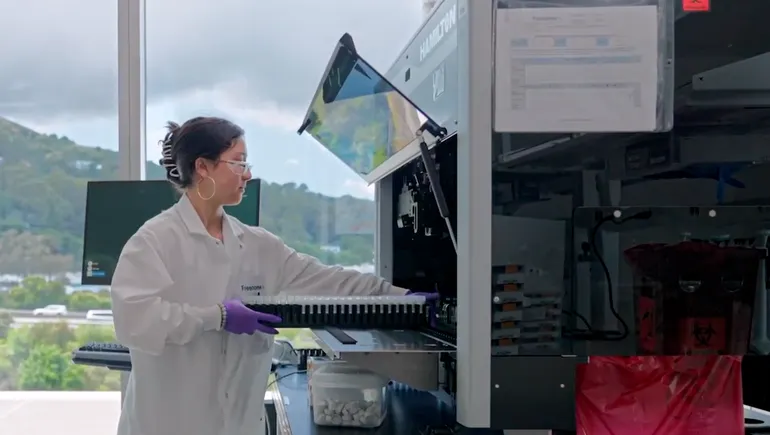
The U.S. Food and Drug Administration has granted formal approval to Freenome’s SimpleScreen, a non-invasive blood-based screening test designed to detect colorectal cancer in adults aged 45 and older who are at average risk for the disease. This regulatory milestone has immediately triggered a $100 million payment to Freenome from its commercial partner, Abbott, under the terms of a strategic agreement established between the two healthcare entities in August 2025. The approval marks a significant shift in the diagnostic landscape, offering a high-compliance alternative to traditional screening methods as the medical community struggles to address a persistent gap in preventative care that leaves tens of millions of Americans vulnerable to one of the most preventable forms of cancer.
Colorectal cancer remains the second leading cause of cancer-related deaths in the United States when data for men and women are combined. Despite the high efficacy of early intervention, a substantial portion of the eligible population remains unscreened. According to data provided by Freenome, approximately 60 million Americans are currently overdue for their recommended colorectal cancer screenings. This "screening gap" is attributed to several factors, including the invasive nature of colonoscopies, the dietary and physical preparations required for stool-based tests, and general patient reluctance regarding traditional diagnostic procedures. The introduction of SimpleScreen aims to lower these barriers by integrating cancer screening into routine blood work performed during standard clinical visits.
Clinical Performance and the PREEMPT CRC Study
The FDA’s decision to approve SimpleScreen was predicated on the results of the PREEMPT CRC study, a massive clinical trial involving more than 48,000 participants. The study was designed to evaluate the test’s ability to identify colorectal cancer signals using cell-free DNA (cfDNA) found in the blood. By analyzing these signals, the test attempts to detect the presence of malignancy at stages where surgical or pharmacological intervention is most effective.
The clinical data submitted to the FDA revealed that SimpleScreen successfully detected approximately 80% of colorectal cancers, meaning it correctly identified 8 out of 10 positive cases. Furthermore, the test demonstrated a specificity rate of 90%, correctly providing negative results for 9 out of 10 individuals who did not have colorectal cancer or advanced precancerous lesions. While these figures represent a breakthrough for blood-based diagnostics, they also highlight the ongoing challenge of balancing sensitivity—the ability to catch every case—with specificity—the ability to avoid false alarms.
SimpleScreen utilizes a multiomics platform, which combines genomic, proteomic, and epigenetic data to create a comprehensive biological profile of the patient’s blood. This approach allows for the detection of subtle molecular changes that occur as a tumor begins to shed DNA into the bloodstream. Unlike stool-based tests, which require the patient to collect and mail a sample, the blood-based nature of SimpleScreen allows for immediate collection in a primary care setting, which advocates suggest will significantly improve patient compliance rates.
Strategic Partnership and Market Dynamics
The commercialization of SimpleScreen is being managed through a high-stakes partnership between Freenome and Abbott. The $100 million milestone payment recently issued by Abbott underscores the perceived market value of blood-based screening. However, the entry of SimpleScreen into the market creates a complex competitive environment, particularly as Abbott also maintains a significant interest in Cologuard, the stool-based DNA test manufactured by Exact Sciences.
Market analysts from TD Cowen have noted that Abbott is likely to navigate this dual-product landscape by positioning SimpleScreen as a secondary option. The prevailing consensus among analysts is that Abbott will continue to prioritize Cologuard for initial screening orders due to its historically superior performance in detecting advanced adenomas—the precancerous growths that are the primary targets of preventative screening. SimpleScreen and other blood-based tests, such as Guardant Health’s Shield, are expected to be marketed primarily to patients who refuse a colonoscopy or a stool-based test, or in cases where previously ordered tests were not completed by the patient.
Despite the partnership with Abbott for the current iteration of SimpleScreen, Freenome has retained the U.S. commercialization rights for future versions of the test. The company intends to integrate these future iterations into a broader multi-cancer early detection (MCED) offering. This long-term strategy reflects a growing trend in the diagnostics industry toward "liquid biopsies" that can screen for multiple types of cancer through a single blood draw, potentially revolutionizing the standard of care for oncology.
The Evolution of Screening Guidelines
The approval of SimpleScreen comes at a critical time as medical guidelines have recently shifted the recommended age for starting colorectal cancer screenings from 50 down to 45. This change, enacted by the U.S. Preventive Services Task Force (USPSTF) and the American Cancer Society, was prompted by a concerning rise in early-onset colorectal cancer cases among younger adults.
The expansion of the screening population has put additional pressure on the healthcare system to provide accessible testing options. While colonoscopy remains the "gold standard" because it allows for both the detection and the immediate removal of precancerous polyps, the sheer volume of the newly eligible population exceeds the capacity of existing gastroenterology facilities. Blood tests like SimpleScreen are viewed as essential "front-line" tools that can risk-stratify the population, ensuring that colonoscopy resources are prioritized for those most likely to have an underlying pathology.
Chronology of Development and Public Listing
The path to FDA approval for Freenome has been marked by rapid scaling and a successful transition to the public markets. Earlier this month, Freenome debuted as a publicly traded company, a move that provided the capital necessary to finalize the regulatory process and prepare for large-scale commercial distribution.
The timeline of the SimpleScreen development is as follows:
- August 2024: Freenome and Abbott ink a definitive commercial agreement to bring blood-based CRC screening to the mass market.
- Early 2025: Freenome completes the data analysis for the PREEMPT CRC study, involving 48,000 subjects across diverse demographics.
- Mid-2025: The company files its Pre-Market Approval (PMA) application with the FDA.
- Late 2025: Freenome launches its Initial Public Offering (IPO), signaling investor confidence in the liquid biopsy sector.
- Current Milestone: The FDA grants formal approval for SimpleScreen, triggering the $100 million milestone payment from Abbott.
Comparative Analysis: SimpleScreen vs. Shield vs. Cologuard
The diagnostic market is currently divided into three main categories: invasive (colonoscopy), non-invasive stool-based (Cologuard, FIT), and non-invasive blood-based (SimpleScreen, Shield).
Guardant Health’s Shield test, which received FDA approval earlier in the year, serves as the primary direct competitor to SimpleScreen. Both tests target the same 45+ average-risk demographic and utilize cfDNA technology. While their sensitivity rates for detecting stage I-IV colorectal cancer are comparable, the industry is closely watching how these tests perform in detecting advanced adenomas. Historically, blood tests have struggled to match the 40-50% adenoma detection rate of stool-based tests like Cologuard.
However, the primary advantage of blood-based tests is "adherence." Real-world data suggests that when offered a blood test, patient completion rates can exceed 90%, whereas stool-based kit return rates often hover between 60% and 70%. For the 60 million Americans who are currently unscreened, the clinical community argues that "the best test is the one that actually gets done."
Broader Implications for Public Health and the Future of Diagnostics
The approval of SimpleScreen is expected to have a ripple effect across the healthcare economy. For insurance providers, the availability of a blood-based test offers a potential cost-saving mechanism by catching cancers at Stage I or II, where treatment costs are significantly lower than the intensive chemotherapy and biological therapies required for Stage IV disease.
Furthermore, the data generated by the PREEMPT CRC study provides a wealth of information for the continued refinement of AI-driven diagnostic algorithms. Freenome’s platform uses machine learning to distinguish between the "noise" of healthy DNA and the specific "signals" of cancer, a process that becomes more accurate as more samples are processed.
As Freenome and Abbott begin the rollout of SimpleScreen, the focus will shift toward securing broad reimbursement coverage from Medicare and private insurers. Under current laws, including the Affordable Care Act, most preventative screenings must be covered without patient cost-sharing if they receive a high rating from the USPSTF. The industry is now waiting to see if the clinical performance of SimpleScreen will lead to such a recommendation in the next update cycle.
In conclusion, the FDA approval of SimpleScreen represents a pivotal moment in the fight against colorectal cancer. By combining the convenience of a routine blood draw with the analytical power of multiomics, Freenome and Abbott are positioned to address the massive screening gap that has long hindered public health efforts. While the colonoscopy remains the definitive diagnostic and therapeutic tool, the addition of a high-compliance blood test to the medical toolkit offers a promising path toward reducing the national burden of colorectal cancer through earlier detection and intervention.
