








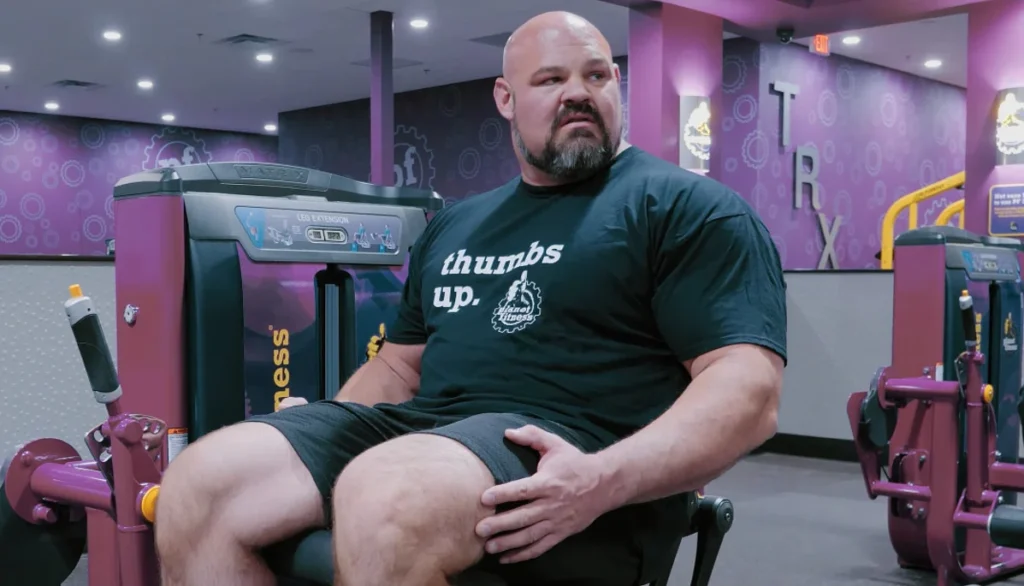
The presence of Shaw and Hall in a "Judgment Free Zone"—the trademarked philosophy of Planet Fitness—presents a stark visual and functional contrast. Planet Fitness, which operates over 2,400 locations globally, is strategically designed to cater to "first-time or casual gym-goers." Its business model deliberately excludes certain types of heavy-duty equipment, such as traditional squat racks and deadlift platforms, to foster an environment that is less intimidating for the average person. Conversely, Shaw and Hall represent the absolute pinnacle of human force production, routinely handling loads that exceed the mechanical capacity of standard commercial machinery.
The Profiles of the Participants
Brian Shaw, a native of Fort Lupton, Colorado, stands 6 feet 8 inches tall and has historically competed at body weights exceeding 400 pounds. His career is defined by consistency and dominance, having secured WSM titles in 2011, 2013, 2015, and 2016. Shaw is widely regarded as one of the most mathematically precise and technically proficient athletes in the sport, often utilizing custom-built equipment at his private facility to accommodate his massive frame and strength levels.
Eddie Hall, known as "The Beast," hails from Newcastle-under-Lyme, England. Standing 6 feet 3 inches tall, Hall’s career peak saw him reach a body weight of nearly 440 pounds. His 2017 WSM victory was the culmination of a singular focus on the title, after which he transitioned into other ventures, including a high-profile boxing match against rival Hafthor Björnsson and various media projects. At the time of this training session, Hall was preparing for a return to competitive strongman as a captain for the World’s Strongest Nation contest.

Chronology of the Workout
The training session focused on the lower body, a muscle group that requires the most substantial external load for athletes of this caliber. Due to the absence of standard Olympic barbells and squat racks—a standard feature of the Planet Fitness "low-barrier" equipment set—the duo was forced to adapt their routine to the available Smith machines and selectorized resistance equipment.
The workout commenced with Smith machine squats. The Smith machine utilizes a barbell fixed within steel rails, allowing only for vertical or near-vertical movement. For Shaw and Hall, the primary obstacle was not the weight itself, but the physical dimensions of the machine. The width of their shoulders and the depth of their torsos made positioning within the frame difficult. Despite these ergonomic constraints, they progressed to loading the machine with five 45-pound plates on each side. Shaw noted the necessity of stabilizing himself by holding the machine’s frame, as the fixed path of the bar did not align perfectly with his natural squat mechanics.
Following the squats, the athletes moved to the selectorized abdominal crunch machine. This equipment is generally calibrated for a resistance range suitable for general fitness enthusiasts. For individuals who have stabilized hundreds of pounds overhead, the maximum weight on the stack provided little more than a warm-up level of resistance.
The third exercise was the leg press. This machine is often a staple for strongmen due to its ability to safely load the quadriceps and glutes without the spinal compression of a free-weight squat. Shaw and Hall loaded the sled with six 45-pound plates per side, adding an additional plate on top of the sled to maximize the load. While this represents a significant weight for most gym-goers (approximately 585 pounds), it remains well below the 1,000-plus pound presses often performed by these athletes in their home gyms.
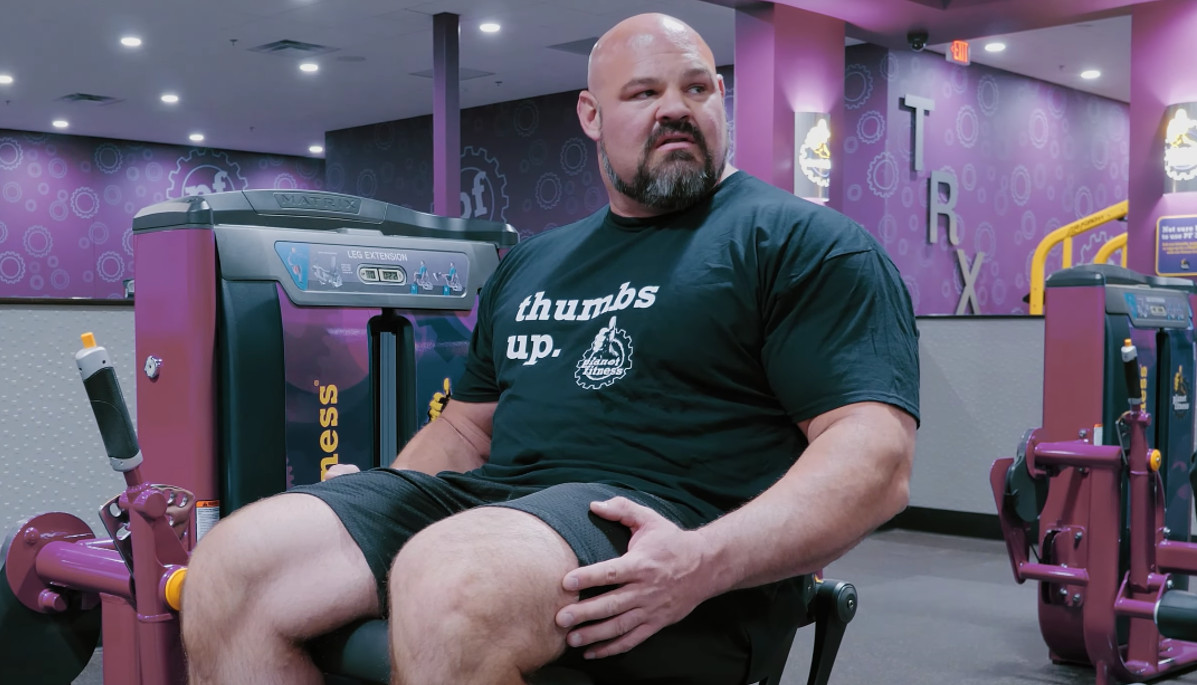
The session continued with a series of isolation movements, including leg extensions, adductor machines, and abductor machines. These pieces of equipment are designed to isolate specific muscle groups, and the athletes utilized the maximum weight available on the stacks for high-repetition sets.
The Competitive Finale: The Circuit Race
To conclude the session, Shaw and Hall engaged in a timed challenge within the Planet Fitness "30-Minute Express Circuit" room. This area is typically reserved for members to perform a full-body workout by following a timed light system. The strongmen modified the rules, requiring one repetition at the maximum weight setting for each of the 20 stations.
This challenge shifted the focus from pure strength to cardiovascular capacity and transition speed. Hall completed the 20-station circuit in 1 minute and 15.09 seconds. Shaw followed closely, finishing in 1 minute and 19 seconds. This segment of the workout emphasized the functional athleticism required in strongman competitions, where "medley" events often require athletes to move between different implements under strict time constraints.
Context and Competitive Implications
The timing of this session is significant within the broader context of the strongman calendar. At the time, Brian Shaw was in an "off-season" phase, focusing on recovery and maintaining his baseline strength while managing his own promotion, the Shaw Classic.
Eddie Hall, however, was in the midst of a specific "prep" phase. After a five-year hiatus from the sport, Hall had announced his return for the World’s Strongest Nation competition, held at the M&S Bank Arena in Liverpool, England, on November 26, 2022. This event featured a "Team UK vs. Team USA" format. Hall was designated as the captain for Team UK, while the 2019 World’s Strongest Man, Martins Licis, was named captain for Team USA.
The World’s Strongest Nation format is designed to be a more spectator-friendly, fast-paced version of the sport, making the circuit-style training at Planet Fitness a somewhat relevant, albeit lighthearted, preparation for the demands of the competition.
Analysis of Commercial Gym Limitations for Elite Athletes
This encounter serves as a practical case study in the limitations of "standardized" fitness equipment. Professional strongmen require specialized implements for several reasons:
- Weight Capacity: Most commercial leg presses and Smith machines have a maximum load rating. While Shaw and Hall stayed within these limits during their visit, their standard training often requires weights that could potentially damage the bearings or structural integrity of entry-level commercial equipment.
- Ergonomics: Equipment designed for the "average" person (typically 5’4" to 6’2") often fails to accommodate the limb lengths and joint widths of "super-heavyweight" athletes.
- Specialization: Strongman is a sport of "odd objects." The absence of Atlas stones, yokes, and log bars in a commercial gym means that an athlete can only train for general hypertrophy and basic strength, rather than the specific skill-based movements required in competition.
Broader Impact on Fitness Culture
The video documenting this session has garnered significant attention, highlighting the cultural gap between "hardcore" strength sports and mainstream fitness. While Planet Fitness is often the subject of criticism within the "serious" lifting community for its "Lunk Alarm"—a siren intended to discourage grunting or dropping weights—Shaw and Hall’s approach was largely respectful of the facility’s rules.
The interaction underscores a growing trend of elite athletes creating "fish-out-of-water" content, which serves to humanize the athletes while showcasing the accessibility of fitness. For Planet Fitness, the presence of two of the world’s strongest men serves as an unintended endorsement of the durability of their equipment, even if it is not the primary choice for such athletes.
Conclusion and Future Outlook
The session ended without the activation of the "Lunk Alarm," suggesting that even the world’s strongest men can operate within the boundaries of a general-population gym when necessary. Following this session, Eddie Hall proceeded to lead Team UK in the World’s Strongest Nation contest, marking his formal return to the competitive arena.
As the sport of strongman continues to grow in popularity, the distinction between specialized "iron paradises" and commercial health clubs remains clear. However, as demonstrated by Shaw and Hall, the fundamentals of resistance training—progressive overload and mechanical tension—can be achieved in almost any environment, provided the athlete is willing to adapt to the tools at hand. The event remains a unique moment in the 2022 strength sports calendar, bridging the gap between the extremes of human performance and the everyday fitness experience.