










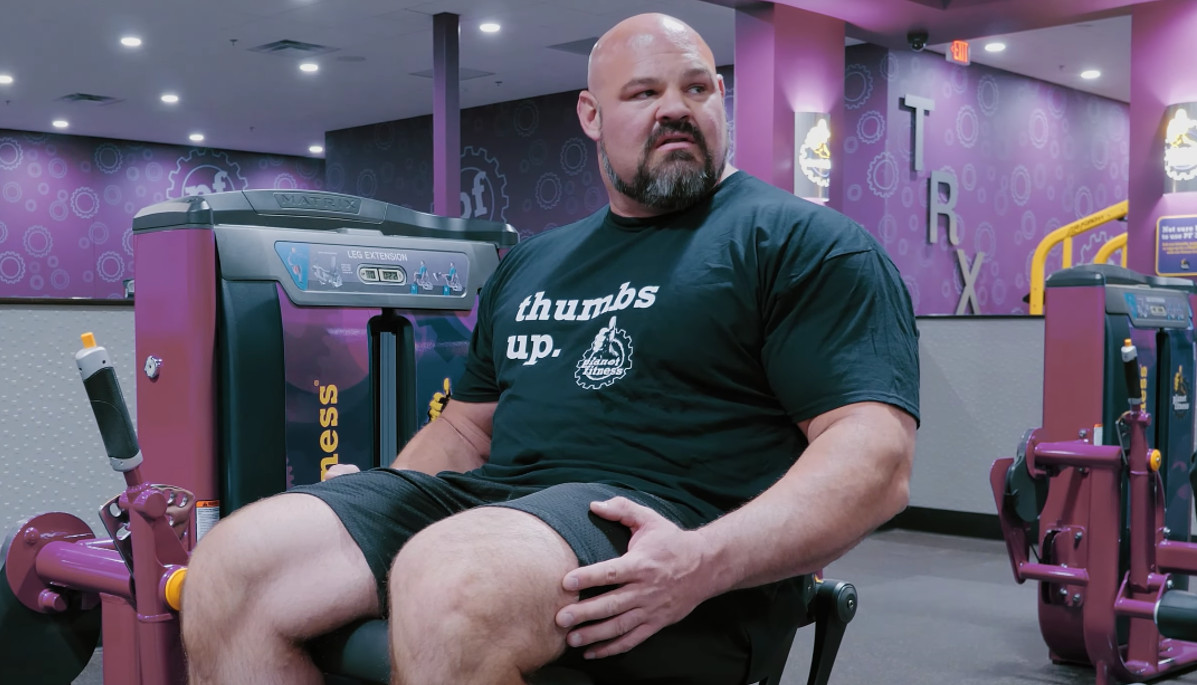
The intersection of elite strength athletics and mainstream commercial fitness recently provided a unique case study in equipment utility and athletic adaptability when two of the most decorated strongmen in history, Brian Shaw and Eddie Hall, conducted a training session at a Planet Fitness location in Colorado. Brian Shaw, a four-time World’s Strongest Man (WSM) champion (2011, 2013, 2015, 2016), and Eddie Hall, the 2017 WSM champion and the first human to deadlift 500 kilograms, documented the experience for Shaw’s digital audience. The encounter served as a stark contrast between the specialized, high-intensity requirements of professional strongman training and the "Judgment Free Zone" philosophy championed by the Planet Fitness franchise.
The Divergence of Training Environments
To understand the logistical challenges faced by Shaw and Hall, one must consider the infrastructure of a standard strongman training facility versus a commercial health club. Professional strongmen typically utilize implements such as Atlas stones, 1,000-pound yokes, log press bars, and farmer’s walk handles—equipment that is virtually non-existent in the 2,000-plus locations operated by Planet Fitness. Furthermore, the Planet Fitness business model is explicitly designed to cater to the general population, specifically the "80 percent" of the public who may feel intimidated by traditional "iron-paradise" gym cultures. This is enforced through the "Lunk Alarm," a siren intended to discourage grunting, slamming weights, or any behavior deemed overly aggressive.
For Shaw, who stands 6 feet 8 inches tall and weighs approximately 400 pounds, and Hall, who has maintained a massive frame even after transitioning to boxing and later returning to strength sports, the physical dimensions of the gym proved to be the first obstacle. The ergonomic design of commercial machines is generally tailored to the 50th to 95th percentile of the human population; athletes of Shaw and Hall’s stature exist well outside these standard deviations.

Chronology of the Training Session
The workout commenced with a focus on the lower body, specifically targeting the quadriceps and glutes. Due to the absence of traditional free-weight squat racks—a standard omission in many Planet Fitness locations to prioritize safety and space—the duo was forced to utilize the Smith machine. This piece of equipment, which fixes the barbell within a vertical track, presents a physiological challenge for elite lifters. The fixed plane of motion prevents the natural bar path required for heavy compound movements, and for athletes with the shoulder width of Shaw and Hall, fitting comfortably under the bar was a technical feat in itself.
Despite these limitations, the pair progressed through several sets, eventually loading the Smith machine with five 45-pound plates on each side. The total weight, while significant for a commercial gym setting, represents a fraction of the loads these men handle in competition. Shaw notably had to stabilize the machine by holding onto its frame, as his sheer power and the weight distribution threatened the stability of the bolted-down unit.
The session continued with accessory movements, including the abdominal crunch machine and the leg press. On the leg press, the athletes reached the machine’s capacity, loading six 45-pound plates per side with an additional plate placed atop the sled. Observations from the session indicated that the mechanical advantage provided by the machine’s pulley and rail system rendered the weight negligible for the former world champions. Following the leg press, they moved through a circuit of isolation movements, including leg extensions, adductor machines, and abductor machines, which are designed to target specific muscle groups that are often neglected in the "big three" power movements but remain essential for injury prevention in strongman.
The Planet Fitness Challenge: A Test of Conditioning
The climax of the visit was a head-to-head competition within the gym’s designated "30-Minute Express Circuit" room. This area is designed for general fitness enthusiasts to perform a full-body workout by moving through 20 stations in a timed sequence. Shaw and Hall adapted this concept into a high-intensity sprint, performing one repetition at maximum machine weight on all 20 stations.
This segment of the workout provided data on the athletes’ cardiovascular recovery and "work capacity"—a metric often overshadowed by raw static strength in the strongman community. Eddie Hall, who had recently undergone a significant body transformation for a high-profile boxing match against Hafthor Bjornsson, displayed superior speed and agility. Hall completed the 20-station circuit in 1 minute and 15.09 seconds. Brian Shaw followed closely, finishing in 1 minute and 19 seconds. The narrow four-second margin highlighted that despite their massive size, both athletes maintain a level of conditioning that rivals many smaller, specialized endurance athletes.
Professional Implications and Competitive Context
The timing of this session is significant within the professional strongman calendar. While Brian Shaw was in a scheduled off-season, focusing on maintenance and brand development, Eddie Hall was in the final stages of preparation for his return to competitive strongman. Hall’s five-year hiatus from the sport ended with his appointment as the captain of Team UK for the "World’s Strongest Nation" contest.
The World’s Strongest Nation event, held on November 26, 2022, at the M&S Bank Arena in Liverpool, represented a shift in the sport’s format, emphasizing team-based points over individual standings. Hall’s role as captain placed him in direct opposition to Team USA, captained by 2019 World’s Strongest Man Martins Licis. The training session at Planet Fitness, while seemingly lighthearted, served as a "deload" or active recovery session for Hall, allowing him to stimulate muscle fibers without the systemic central nervous system (CNS) fatigue associated with heavy log presses or deadlifts.
Analysis of the "Commercial Gym" Phenomenon
The presence of Shaw and Hall at a Planet Fitness reflects a broader trend in the fitness industry where elite athletes utilize "common" spaces to engage with a wider audience. From a marketing perspective, the video serves to humanize the sport of strongman, which is often viewed as a fringe activity performed by "giants" in secluded warehouses.
However, the session also underscored the limitations of the "Judgment Free" model when applied to extreme physiology. The "funny noises" prank mentioned in the video’s metadata refers to the tension between the natural physiological requirements of heavy lifting (exhalation and grunting) and the gym’s strict noise policies. While no "Lunk Alarm" was officially triggered during the recorded session, the visual of two 400-pound men using machines designed for the average office worker highlighted the mechanical strain placed on commercial-grade equipment by professional-grade force production.
Broader Impact on the Strength Community
The reaction from the fitness community to this crossover event has been largely positive, highlighting a growing interest in the intersection of different training philosophies. By documenting their attempt to train in a restrictive environment, Shaw and Hall provided a practical demonstration of "functional hypertrophy"—the ability to use muscle mass effectively across various planes and machines, not just specialized implements.
Furthermore, the data points gathered from the circuit race (1:15 and 1:19) provide a benchmark for the "explosive power" of strongmen. Moving between 20 different machines and adjusting weights in under 80 seconds requires a level of lactic acid threshold management that is rarely discussed in the context of World’s Strongest Man coverage.
Conclusion
The visit to Planet Fitness by Brian Shaw and Eddie Hall remains a notable moment in recent strength sports history. It served as a reminder that while specialized equipment is necessary for the highest levels of competition, the fundamental principles of resistance training—progressive overload, mechanical tension, and metabolic stress—can be applied in any environment, provided the athlete is willing to adapt.
As the sport of strongman continues to grow in popularity, driven by the digital presence of figures like Shaw and Hall, the industry may see a shift in how commercial gyms accommodate high-output athletes. For now, the "Planet Fitness takeover" stands as a testament to the versatility of two of the greatest strength athletes of the modern era, proving that even in a "Judgment Free Zone," the pursuit of elite strength remains a spectacle of its own.