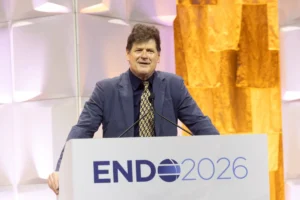










The Endocrine Society recently concluded a high-profile participation at the Evidence Based Health Care (EBHC) 2026 Conference, held from October 21 to 24 in the historic city of Taormina, Italy. This international gathering served as a critical nexus for clinical experts, methodologists, and digital health innovators to address the evolving landscape of medical evidence synthesis. Representing the Endocrine Society were key leaders in the field of clinical practice development, including Roma Gianchandani, MD, Chair of the Clinical Guidelines Committee; Christopher R. McCartney, MD, Endocrine Society Guideline Methodologist and Board of Directors member; Maureen Corrigan, MPH, Director of Evidence Based Practice; and Katie Delaney, Program Manager of Evidence Based Practice. Their presence underscored the Society’s commitment to maintaining rigorous, transparent, and globally aligned standards in the creation of clinical practice guidelines (CPGs).
The EBHC 2026 conference was a milestone event, organized as a joint meeting that combined the 11th EBHC International Conference with the 11th Conference of the International Society for Evidence-Based Health Care (ISEHC). By bringing together two major pillars of the evidence-based community, the summit fostered a comprehensive dialogue on the integration of artificial intelligence (AI) and digital transformation within research, clinical practice, and healthcare delivery systems.
A Strategic Focus on Digital Transformation and AI Integration
The central theme of the 2026 conference focused on the paradigm shift currently occurring in the production and dissemination of medical evidence. As the volume of clinical data grows exponentially, traditional methods of evidence synthesis—often requiring years of manual review and consensus-building—are increasingly viewed as insufficient for the fast-paced needs of modern medicine.

Delegates from the Endocrine Society joined global experts to dissect how AI and sophisticated digital tools are revolutionizing the methodology of evidence production. A primary area of discussion involved the use of machine learning algorithms to automate the screening of vast quantities of medical literature. In the current landscape, medical researchers must sift through thousands of peer-reviewed papers to identify high-quality evidence for a single guideline update. AI-driven screening tools have the potential to reduce this workload by up to 30% to 50%, allowing human experts to focus their efforts on the interpretation of nuanced data rather than the manual categorization of search results.
Furthermore, the conference delved into the development of "living guidelines." This concept involves procedures designed to keep clinical practice recommendations updated as close to real-time as possible. By utilizing digital infrastructure that continuously monitors new trial data and publication outputs, medical societies can issue rapid updates to specific recommendations without waiting for the traditional five-to-ten-year revision cycle of an entire guideline document.
Chronology of the EBHC 2026 Conference
The four-day summit in Taormina followed a structured agenda designed to bridge the gap between theoretical methodology and practical clinical application:
- October 21: Pre-Conference Workshops and Governance Meetings: The opening day focused on the foundational mechanics of evidence-based healthcare. Leaders from various international medical societies met to discuss the harmonization of methodology across different specialties. The Endocrine Society delegation engaged in high-level discussions regarding the "GRADE" (Grading of Recommendations Assessment, Development and Evaluation) framework, which remains the gold standard for assessing the quality of evidence.
- October 22: The Rise of AI in Evidence Synthesis: The first full day of the general session addressed the digital transformation. Keynote speakers highlighted the role of Natural Language Processing (NLP) in extracting data from clinical trials. The Endocrine Society representatives participated in panels discussing the ethical implications of AI-generated summaries and the necessity of human oversight in maintaining guideline integrity.
- October 23: Global Standards and Healthcare Delivery: Discussions shifted toward the practical implementation of evidence at the point of care. Experts explored how digital guidelines can be integrated directly into Electronic Health Records (EHRs) to provide real-time decision support for physicians.
- October 24: Closing Plenary and Future Directives: The final day focused on the "Taormina Declaration" and the roadmap for 2030. The emphasis was placed on ensuring that evidence-based practices are accessible to low- and middle-income countries, ensuring that digital advancements do not widen the global health equity gap.
Supporting Data: The Growing Need for Automated Evidence Processing
The urgency behind the EBHC 2026 agenda is supported by the sheer scale of modern scientific output. According to data tracked by the National Library of Medicine, over one million new citations are added to the PubMed database annually. For a specialized field like endocrinology, which covers a vast array of conditions from diabetes and thyroid disorders to rare adrenal pathologies, the task of maintaining current recommendations is a monumental undertaking.
Recent studies into guideline "decay" suggest that approximately 20% of clinical recommendations may become outdated within three years of publication as new evidence emerges. This "evidence-to-practice gap" is what the Endocrine Society and its international partners are striving to close. By adopting digital tools discussed in Taormina, the Society aims to transition from a static publication model to a dynamic, evidence-responsive framework.
Official Responses and Strategic Vision
The Endocrine Society’s participation in the international evidence community is viewed as a vital component of its mission to improve public health. Katie Delaney, Program Manager for Evidence Based Practice at the Society, emphasized the importance of this global collaboration. According to Delaney, taking part in the EBHC conference "keeps the Society’s guideline methodology in line with global standards and helps shape how guidelines will be made in the future."
This sentiment reflects a broader strategic shift within the organization. By participating in the ISEHC, the Society ensures that its clinical recommendations are not developed in a vacuum but are instead built upon the most rigorous methodological foundations recognized by the international scientific community. This alignment is crucial for the global adoption of the Society’s guidelines, which are frequently used by clinicians in Europe, Asia, and the Americas as the definitive source for endocrine care.
Roma Gianchandani, MD, in her capacity as Chair of the Clinical Guidelines Committee, has been a proponent of streamlining the guideline development process without sacrificing the "gold standard" quality for which the Endocrine Society is known. The insights gained from the Taormina conference regarding AI-assisted literature reviews are expected to inform the Society’s internal processes for upcoming guidelines on metabolic health and hormone replacement therapies.
Broader Impact and Implications for Clinical Practice
The implications of the EBHC 2026 conference extend far beyond the meeting halls of Italy. The digital transformation of evidence-based healthcare carries several significant consequences for the global medical community:
1. Reduction of Physician Information Overload
As guidelines become more digitally integrated, the goal is to provide clinicians with "just-in-time" information. Instead of requiring a physician to read a 100-page guideline document, digital tools can surface the relevant recommendation at the moment a specific diagnosis is entered into a patient’s chart. This reduces the cognitive load on healthcare providers and improves adherence to best practices.
2. Accelerated Knowledge Translation
Historically, it could take up to 17 years for a new clinical discovery to become standard practice in the field. The movement toward "living guidelines" and real-time evidence updates aims to slash this timeline, ensuring that patients benefit from the latest breakthroughs in medical science almost as soon as they are validated.
3. Enhanced Precision in Endocrinology
Endocrinology is a field defined by precise hormonal balances and complex feedback loops. The integration of AI allows for a more granular analysis of patient subgroups within clinical trials. This supports the development of more personalized guidelines that account for genetic, environmental, and demographic variations, moving the field closer to the ideal of precision medicine.
4. Quality Control and Trust
In an era of misinformation, the role of established medical societies like the Endocrine Society becomes even more critical. By leveraging AI within a framework of rigorous peer review and professional oversight, the Society reinforces its position as a trusted source of truth. The conference in Taormina reinforced the principle that while AI can assist in data processing, the ultimate responsibility for clinical recommendations must remain with expert human clinicians.
Future Outlook: The Road to 2030
The EBHC 2026 conference served as a precursor to the next decade of healthcare evolution. As the Endocrine Society integrates the methodologies discussed in Taormina, the focus will likely shift toward the creation of a "global evidence ecosystem." This ecosystem envisions a world where data from clinical trials, real-world evidence from patient registries, and expert clinical consensus are synthesized through a unified digital pipeline.
For the Endocrine Society, the mission remains clear: to provide the most accurate, evidence-based guidance to improve the lives of patients with endocrine disorders worldwide. The collaboration in Taormina ensures that the Society remains at the forefront of medical methodology, utilizing the best of modern technology to uphold the timeless principles of scientific rigor and clinical excellence.
As the Society moves forward, the lessons from EBHC 2026 will be reflected in its forthcoming clinical practice guidelines, which will increasingly utilize digital-first formats and more frequent, evidence-driven updates. This proactive approach ensures that the Endocrine Society continues to lead the way in a rapidly changing digital landscape, setting the standard for how medical evidence is produced and put into practice in the 21st century.