

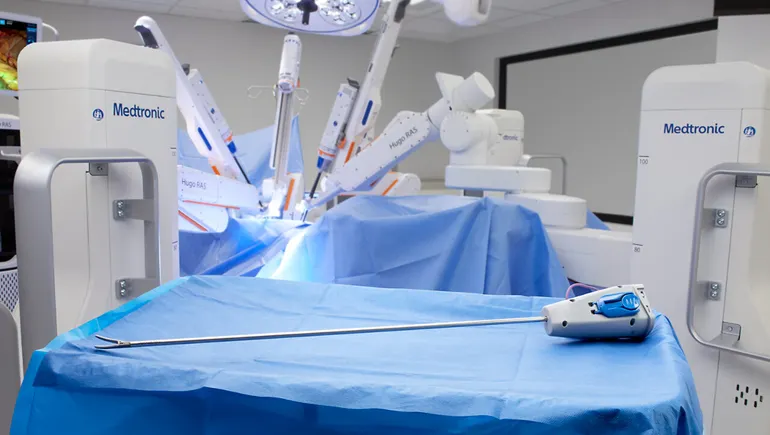
Medtronic, a global leader in medical technology, has officially announced that it received 510(k) clearance from the U.S. Food and Drug Administration (FDA) for its LigaSure RAS Maryland instrument designed for use with the Hugo robotic-assisted surgery (RAS) system. This regulatory milestone marks a significant expansion of Medtronic’s surgical robotics portfolio in the United States, bringing one of the company’s most trusted energy-based surgical tools into the high-growth robotic surgery market. The clearance of the Maryland bipolar dissector and vessel sealer is a central component of Medtronic’s broader strategy to scale the Hugo system across various surgical specialties, including general surgery and gynecology.
The Hugo RAS system is a modular, multi-quadrant platform designed to combine the precision of robotic technology with the flexibility of individual robotic arms. By integrating the LigaSure technology—a staple in operating rooms for over two decades—Medtronic aims to provide surgeons with a seamless transition from traditional laparoscopic and open procedures to robotic-assisted workflows. The move is widely seen as a direct challenge to the dominance of Intuitive Surgical’s Da Vinci system, as Medtronic seeks to capture a larger share of the multi-billion dollar robotic-assisted surgery market.
The Technical Significance of the LigaSure RAS Maryland Instrument
The LigaSure technology is an advanced vessel-sealing platform that uses a proprietary combination of pressure and radiofrequency (RF) energy to create a permanent, fused seal of vessel walls and tissue bundles. Unlike traditional suturing or standard bipolar cautery, LigaSure provides a consistent seal that can withstand significantly higher physiological blood pressure. The Maryland instrument variant, characterized by its curved tip, allows for precise dissection, grasping, and cold cutting, making it a versatile "all-in-one" tool for surgeons navigating complex anatomical structures.
In the context of robotic surgery, the LigaSure RAS Maryland instrument offers several distinct advantages. It provides surgeons with enhanced haptic-like feedback and wrist-like maneuverability through the Hugo system’s controllers. This allows for greater dexterity in tight surgical fields, such as the pelvic cavity during gynecological procedures or the upper abdomen during general surgical cases. For hospitals, the integration of a tool that surgeons are already familiar with in laparoscopic settings reduces the learning curve associated with adopting a new robotic platform.
Chronology of Development and Regulatory Milestones
The path to FDA clearance for the LigaSure RAS Maryland instrument follows a multi-year effort by Medtronic to globalize its robotic surgery offerings. The Hugo system itself has undergone rigorous clinical testing and regulatory scrutiny across multiple continents.
In early 2024, Medtronic achieved a major milestone when the Hugo RAS system received its initial FDA clearance for specific urological indications. Following this, in June 2024, the company revealed it had submitted several 510(k) filings to the FDA. These filings were intended not only to clear new instruments like the LigaSure Maryland but also to expand the system’s cleared indications to include general surgery and gynecology, which represent the highest volume segments of the surgical market.
Internationally, Medtronic has had a head start. The company received a CE Mark for the robotic version of its LigaSure technology in Europe in July 2024. This allowed European surgeons to utilize the technology nearly a year before their American counterparts. To date, the Hugo system is operational in more than 35 countries. The recent U.S. clearance for the LigaSure instrument serves as the final piece of the puzzle for Medtronic’s domestic rollout, aligning its U.S. capabilities with its international presence.
Strategic Objectives and Financial Projections
During Medtronic’s first-quarter earnings call for the 2025 fiscal year, CEO Geoff Martha highlighted the pivotal role the Hugo system plays in the company’s long-term growth strategy. Martha informed investors and analysts that Medtronic expects the Hugo system to surpass 50,000 completed procedures globally by the end of the current financial year in April 2025.
This ambitious target reflects the rapid adoption of the platform in markets like Europe, Latin America, and Asia-Pacific. However, the U.S. market remains the most lucrative and competitive landscape for medical devices. The clearance of the LigaSure instrument is expected to accelerate hospital system adoption in the U.S., as many surgical departments prioritize platforms that offer a comprehensive suite of advanced energy tools.
Financially, the expansion into general surgery and gynecology is critical. According to industry data, general surgery accounts for nearly 45% of all robotic procedures performed annually in the United States. By securing the tools necessary for these procedures, Medtronic is positioning itself to compete for high-volume contracts with major healthcare networks.
Perspectives from Medical Leadership
The integration of LigaSure into the Hugo platform has been met with positive reactions from the surgical community. Dr. Matthew Kroh, Chief Medical Officer of Medtronic’s surgical business, emphasized the importance of clinical confidence in the operating room.
"Vessel sealing sits at the center of how surgeons work through the most demanding moments of a procedure," Kroh stated. He noted that surgeons have relied on LigaSure for decades across open and laparoscopic surgery. By bringing that same performance to the Hugo RAS system in the U.S., Medtronic is ensuring that surgeons can carry the "confidence and control" they already trust into the robotic environment.
Surgeons often cite the "instrument gap"—the difference between the tools available in laparoscopy versus robotics—as a barrier to robotic adoption. Medtronic’s strategy of porting its existing, market-leading technologies into the robotic space addresses this friction point directly. The goal is to make the robotic console feel like a natural extension of the surgeon’s existing skill set rather than an entirely new paradigm.
Analyzing the Competitive Landscape
The robotic-assisted surgery market has long been dominated by Intuitive Surgical, whose Da Vinci platform has held a near-monopoly for over two decades. However, the entry of Medtronic’s Hugo system and Johnson & Johnson’s upcoming Ottava system signals a shift toward a more fragmented and competitive market.
Medtronic’s competitive advantage lies in its massive existing footprint in traditional surgery. Almost every hospital in the U.S. already uses Medtronic’s staples, energy devices, and patient monitoring systems. By offering a robotic platform that utilizes these familiar consumables, Medtronic provides a "one-stop-shop" ecosystem that can be more cost-effective for hospital procurement departments compared to maintaining separate vendors for robotic and non-robotic supplies.
Furthermore, the Hugo system’s modularity—where each arm is on its own mobile cart—contrasts with the Da Vinci’s large, multi-arm "boom" architecture. This modularity allows hospitals to move arms between operating rooms and scale the system based on the complexity of the procedure, potentially offering a lower total cost of ownership for smaller community hospitals.
Broader Implications for Healthcare and Patient Outcomes
The expansion of robotic-assisted surgery via platforms like Hugo and instruments like LigaSure has broad implications for the healthcare system. Robotic surgery is associated with several patient benefits, including reduced blood loss, shorter hospital stays, and quicker recovery times compared to traditional open surgery.
As Medtronic scales its operations, the increased competition is likely to drive innovation and potentially lower the costs of robotic procedures. Historically, the high cost of robotic systems and per-procedure consumables has limited their use to high-resource settings. Medtronic’s entry into the U.S. general surgery market with a familiar toolset could help democratize access to robotic surgery, making it a viable option for a wider range of patients and procedures.
Moreover, the data-rich environment of the Hugo system—which captures video and kinematic data—offers opportunities for AI-driven surgical training and quality improvement. As more procedures are performed with the LigaSure RAS Maryland instrument, Medtronic will be able to refine its digital ecosystem, providing surgeons with insights that could further improve clinical outcomes.
Future Outlook for Medtronic’s Surgical Robotics Division
Looking ahead, Medtronic is expected to continue its aggressive pursuit of regulatory clearances for additional instruments and indications. The company is currently focused on optimizing its supply chain to meet the anticipated demand in the U.S. market following the LigaSure clearance.
While the 50,000-procedure milestone is a key short-term goal, the long-term success of the Hugo system will depend on its ability to demonstrate clinical equivalence or superiority to established platforms. With the FDA’s latest clearance, Medtronic has cleared a major hurdle, providing its sales force with the necessary tools to challenge the status quo in American operating rooms.
The medical technology industry will be watching closely as the Hugo system rolls out across U.S. hospitals through the remainder of 2024 and into 2025. The success of this launch will likely determine Medtronic’s trajectory in the surgical space for the next decade, as it seeks to transition from a provider of surgical tools to a leader in the digital, robotic-led future of healthcare.
