

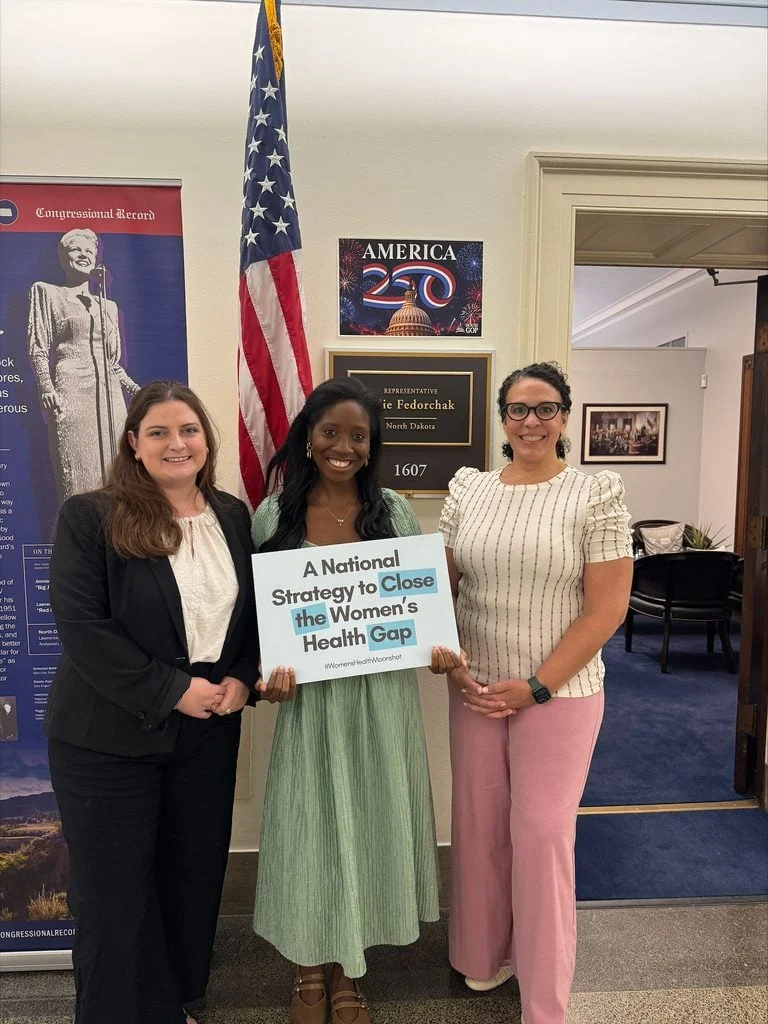
On September 29, a coalition of the nation’s leading medical societies and health advocacy groups converged on Capitol Hill to issue a unified call for a transformative shift in the American healthcare landscape. Representing the Endocrine Society, the Society for Women’s Health Research (SWHR), the American College of Obstetricians and Gynecologists (ACOG), and the Women First Research Coalition (WFRC), delegates met with lawmakers to champion the National Strategy to Close the Women’s Health Gap. This ambitious legislative and policy framework seeks a bold, strategic $20 billion investment over the next decade to rectify decades of systemic underfunding, research exclusion, and clinical neglect that have left women’s health needs secondary to male-centered medical models.
The advocacy day served as a critical follow-up to the official unveiling of the strategy in July, which received endorsements from more than 20 prominent health organizations. Leading the charge for the Endocrine Society was Mya Walters, Manager of Health Policy and Advocacy, who joined forces with Anna Day of the Autoimmune Association and Carly León of the Society of Gynecologic Oncology (SGO). Their presence in the halls of Congress, including meetings at the office of Representative Julie Fedorchak (R-ND), signaled a bipartisan push to treat women’s health not as a niche interest, but as a fundamental pillar of national productivity and public welfare.
The Economic and Clinical Necessity of a Twenty Billion Dollar Investment
The cornerstone of the National Strategy is the demand for a $20 billion federal investment distributed over 10 years. While the figure is significant, proponents argue it is a necessary correction for a historical deficit. For decades, medical research was conducted primarily on male subjects—both human and animal—under the flawed assumption that female biology was merely a variation of the male "default," complicated only by reproductive hormones. This "male-as-model" approach has resulted in a dearth of data regarding how diseases manifest differently in women, how medications are metabolized by the female body, and how hormonal fluctuations throughout the lifespan influence overall health.
The proposed funding aims to bridge this gap by accelerating discovery in areas that disproportionately or uniquely affect women. This includes not only reproductive health and maternal mortality but also chronic conditions such as autoimmune diseases, Alzheimer’s, and cardiovascular disease. By dedicating $2 billion annually, the strategy intends to provide the National Institutes of Health (NIH) and the Centers for Disease Control and Prevention (CDC) with the resources necessary to mandate sex-as-a-biological-variable (SABV) in all levels of research, from basic bench science to late-stage clinical trials.
A Chronology of Advocacy: From 1993 to the Present
The current push for the National Strategy is rooted in a timeline of incremental progress and persistent obstacles. The journey toward equity began in earnest with the National Institutes of Health (NIH) Revitalization Act of 1993. This landmark legislation was a response to the revelation that women were being excluded from clinical trials, often due to concerns over potential pregnancy or the perceived "noise" caused by menstrual cycles. The 1993 Act required the inclusion of women and minorities in NIH-funded clinical research, a move that fundamentally changed the demographics of study participants.
However, three decades later, the limitations of the 1993 Act have become clear. While women are now included in trials, they are frequently not represented in sufficient numbers to allow for sex-specific subgroup analysis. Furthermore, the inclusion mandate did not fully extend to the early stages of drug development or basic laboratory research. In 2016, the NIH implemented a policy requiring researchers to consider sex as a biological variable, but enforcement and implementation remain inconsistent.
The timeline of the current National Strategy began in early 2024, catalyzed by a growing recognition among medical professionals that the pace of change was too slow. In July, the strategy was officially launched, providing a roadmap for legislative action. The September 29 "Hill Day" represented the transition from policy development to active lobbying, as experts provided members of Congress with the data necessary to justify large-scale federal expenditures.
Addressing the Data Gap: Supporting Evidence for Reform
The urgency of the National Strategy is supported by a growing body of evidence highlighting the "health gap" in real-world outcomes. Despite making up more than half of the U.S. population, women continue to face significant disparities in diagnosis and treatment.
- Autoimmune Prevalence: Approximately 80% of people diagnosed with autoimmune diseases are women. Conditions such as lupus, rheumatoid arthritis, and multiple sclerosis affect women at staggering rates, yet the underlying biological reasons for this female predisposition remain poorly understood.
- Cardiovascular Misdiagnosis: Heart disease is the leading cause of death for women in the United States. However, because women often present with "atypical" symptoms—such as fatigue, nausea, or jaw pain, rather than the classic crushing chest pain associated with male heart attacks—they are significantly more likely to be misdiagnosed or discharged from emergency departments without appropriate intervention.
- Neurological Disparities: Two-thirds of Americans living with Alzheimer’s disease are women. While longevity plays a role, researchers believe there are unique hormonal and genetic factors at play that have yet to be fully decoded due to a lack of sex-specific neurological research.
- Maternal Mortality Crisis: The United States maintains the highest maternal mortality rate among developed nations, a crisis that disproportionately affects Black and Indigenous women. The National Strategy emphasizes that maternal health cannot be solved in isolation; it requires a comprehensive understanding of a woman’s health before, during, and after pregnancy.
The Five Key Priorities of the National Strategy
To address these disparities, the National Strategy to Close the Women’s Health Gap focuses on five strategic pillars designed to create a sustainable and equitable healthcare ecosystem:
1. Increasing Federal Research Funding
The strategy calls for a massive infusion of capital specifically earmarked for women’s health research across all NIH institutes. This is intended to move beyond "bikini medicine"—the historical tendency to focus only on breasts and reproductive organs—and instead study the female body as an integrated system.
2. Improving Clinical Trial Diversity and Design
Beyond merely including women, the strategy advocates for trial designs that require sex-based analysis of results. It also emphasizes the need for intersectional diversity, ensuring that clinical trials include women of different ages, races, and socioeconomic backgrounds to ensure that medical breakthroughs are effective for all populations.
3. Expanding and Diversifying the Research Workforce
The strategy recognizes that the questions asked in research are often determined by who is doing the asking. By providing grants and career development opportunities for female scientists and those specializing in women’s health, the initiative seeks to foster a more inclusive and representative scientific community.
4. Standardizing Data Collection and Implementation
One of the greatest hurdles in women’s health is the fragmentation of data. The National Strategy promotes the development of standardized metrics for collecting sex-specific data in electronic health records and public health databases, ensuring that clinicians have access to the best available evidence at the point of care.
5. Enhancing Public Health Education and Awareness
Closing the gap requires empowering women to advocate for their own health. The strategy includes provisions for national public awareness campaigns to educate women about sex-specific symptoms of common diseases and the importance of participating in clinical research.
Official Responses and the Economic Case for Change
The reaction from the medical community has been overwhelmingly supportive, with leaders from the Endocrine Society and ACOG emphasizing that the "status quo" is no longer acceptable. In statements following the Capitol Hill meetings, representatives noted that investing in women’s health is not merely a matter of social justice but an economic imperative.
A recent report by Women’s Health Access Matters (WHAM) suggested that even a modest increase in funding for women’s health research could yield a massive return on investment. For example, doubling the current NIH budget for research on coronary artery disease in women could return $13 billion to the U.S. economy through increased productivity and reduced healthcare costs. Similarly, investing in rheumatoid arthritis research for women could result in a $10 billion economic gain. By addressing the $20 billion goal of the National Strategy, the coalition argues that the U.S. could see hundreds of billions of dollars in long-term economic benefits.
Lawmakers have shown varying degrees of receptivity. While the $20 billion price tag is a point of contention in a fiscally constrained environment, the bipartisan nature of the issues—particularly maternal health and Alzheimer’s—provides a potential pathway for legislative progress. The advocacy of groups like the Endocrine Society is vital in keeping these issues on the legislative calendar.
Broader Implications and the Path Forward
The success of the National Strategy to Close the Women’s Health Gap would represent a paradigm shift in global medicine. For too long, the medical establishment has operated on the assumption that what works for men will work for women, often with disastrous results. From the withdrawal of drugs that were found to have dangerous side effects only in women to the chronic underdiagnosis of debilitating conditions like endometriosis and PCOS, the costs of the health gap are measured in human lives and suffering.
As the Endocrine Society and its partners continue their work on Capitol Hill, the focus remains on ensuring that women’s health is prioritized as a permanent fixture of federal policy. The 10-year timeline of the strategy is intentional; it acknowledges that the gaps created over centuries cannot be closed overnight. It requires a sustained, multi-generational commitment to scientific integrity and medical equity.
The National Strategy is more than a request for funding; it is a call for a new era of medicine where the health of more than half the population is no longer treated as an afterthought. By securing the requested $20 billion investment, the coalition aims to ensure that the next generation of women will benefit from a healthcare system that understands, respects, and effectively treats the complexities of the female body. The meetings on September 29 were just one step in a long journey, but they represent a significant escalation in the fight for a healthier, more equitable future for all Americans.
