









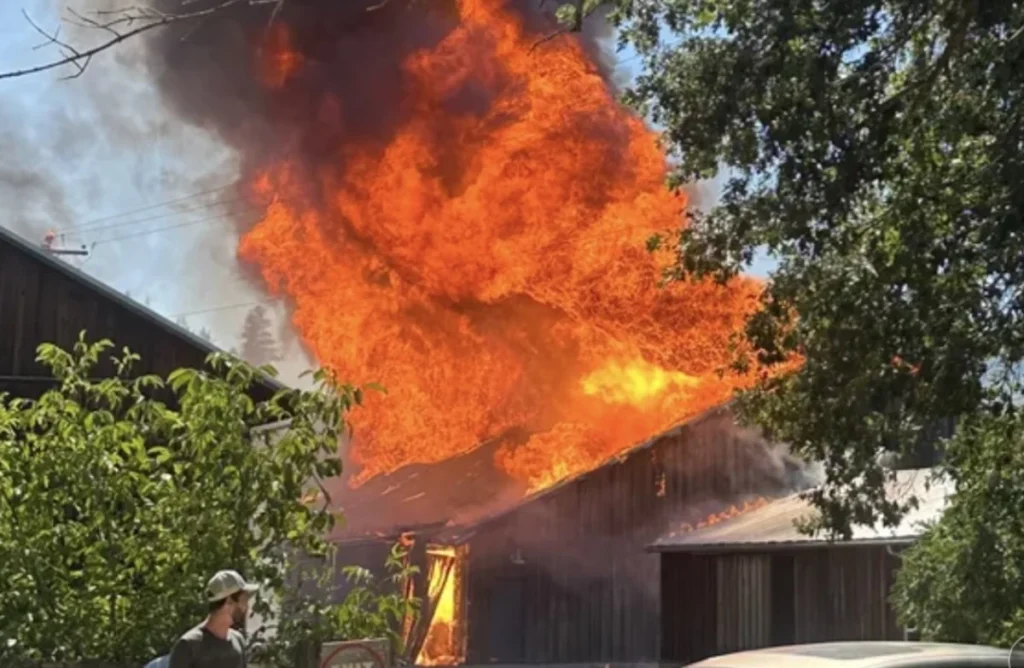
GRANTS PASS, OR – A catastrophic fire swept through Oshala Farm, a prominent herbal producer and bulk ingredient supplier, on Tuesday afternoon, July 8, 2026, resulting in the complete destruction of its warehousing and drying facilities. The blaze also consumed the farm’s extensive inventory of dried herbs, some of which represent years of dedicated cultivation and harvesting. While no human lives were lost, the economic and operational impact on the Applegate Valley cornerstone is profound.
The fire, the cause of which remains under investigation, reportedly ignited in the company’s principal drying barn. Fueled by the arid conditions and the abundance of dry plant material, the flames rapidly spread to an adjacent machine shop and a second drying barn. In total, four structures were lost to the inferno.
A Swift and Devastating Inferno
The incident unfolded quickly on Tuesday. Emergency services were alerted to the fire around mid-afternoon. Local fire departments, including the Applegate Fire District, responded with urgency. The Oregon Department of Forestry also deployed a firefighting helicopter to assist in combating the blaze, recognizing the immediate threat to surrounding natural areas.

Despite the prompt and coordinated response, the fire presented a formidable challenge. High temperatures, coupled with the dry, tinder-like nature of the herbal inventory, created an environment where containment was exceptionally difficult. Firefighters described the conditions as intensely challenging, making it a strenuous effort to control the spread. Their efforts, however, were successful in preventing the fire from encroaching upon the nearby forest, a critical environmental concern in the region. Additionally, a residence located on the Oshala Farm property was successfully protected.
Unrecoverable Losses: Inventory and Infrastructure
The financial and operational implications of the fire are staggering. Oshala Farm is renowned for its cultivation of up to 75 different varieties of medicinal and culinary herbs, all grown using organic and regenerative farming practices. The company is recognized as the second-largest such farm in the United States, underscoring its significance in the national supply chain for herbal ingredients.
The entirety of its dried herb inventory has been lost. This is not a minor setback; many of these herbs require multi-year cycles from planting to harvest, making their replenishment a long and arduous process. The destruction of specialized warehousing and drying facilities means that the farm’s ability to process and store future harvests is severely compromised. The loss extends beyond raw materials to the infrastructure necessary for their preparation and distribution.
Community Impact and Economic Ripple Effects
The fire at Oshala Farm has sent ripples of concern throughout the Applegate Valley, a region that relies heavily on its agricultural sector. Chris Wolfard, Chief of the Applegate Fire District, was quoted by local television station KVAL 13, emphasizing the farm’s deep integration into the community fabric. "Oshala Farm is more than a business – it is a cornerstone of the Applegate Valley," Chief Wolfard stated, highlighting the farm’s vital role beyond its economic contributions.
This sentiment is echoed by the farm’s employment figures. Oshala Farm provides jobs for 58 local residents, with a significant portion, nearly 40, holding full-time positions. The immediate aftermath of the fire raises questions about the job security of these individuals and the broader economic stability of families dependent on these roles. The loss of such a substantial employer could have a lasting negative impact on the local economy.
A Glimmer of Hope: Fields and Equipment Spared
Amidst the devastation, there are elements of resilience. Owners Elise and Jeff Higley confirmed that their entire crop currently in the fields remains intact. This provides a crucial, albeit long-term, pathway to future production. Furthermore, farm employees, demonstrating remarkable dedication and quick thinking, managed to save all of the farm’s tractors and other mobile equipment. This means that while the processing and storage capabilities are gone, the fundamental tools for cultivation and transport are still available, offering a critical advantage in the rebuilding process.

The Road to Recovery: A Community Rallies
In response to the overwhelming loss, the Higleys have launched a GoFundMe campaign to support the monumental task of rebuilding. The community’s response has been swift and generous. Within the first 24 hours of the campaign’s launch, nearly $140,000 was raised, bringing them a significant step closer to their $250,000 goal.
The campaign’s appeal, shared on the GoFundMe site, outlines the immediate needs and the profound gratitude of the owners: "To ask for help at this time is humbling. With your donation, we will begin the rebuilding of our processing facilities, rebuying equipment, and keeping our amazing team working while we figure out what to do next." This statement underscores the dual focus of their recovery efforts: restoring infrastructure and maintaining the livelihoods of their dedicated staff.
Broader Implications for the Herbal and Supplement Industries
The destruction at Oshala Farm serves as a stark reminder of the vulnerabilities inherent in agricultural supply chains, particularly for specialized crops with long growth cycles. The herbal and dietary supplement industries rely on a consistent and reliable supply of high-quality ingredients. A disruption of this magnitude at a farm of Oshala’s size and significance could have cascading effects on product availability and pricing for numerous businesses that depend on their herbs.
Companies that source raw materials from Oshala Farm will now face the immediate challenge of finding alternative suppliers. This could lead to increased demand and potentially higher costs from other producers, or it may necessitate a search for new sourcing partners, which can be a time-consuming and complex process. The long-term implications could include a re-evaluation of supply chain diversification strategies within the industry, with a greater emphasis on mitigating risks associated with single-source dependencies.
The regenerative and organic farming practices employed by Oshala Farm are increasingly valued by consumers and industry stakeholders alike, driven by growing demand for sustainably produced and ethically sourced products. The loss of such a prominent proponent of these methods is a blow to the broader movement towards more environmentally conscious agriculture.
A History of Excellence and Community Dedication
Oshala Farm, established with a commitment to ecological stewardship and the production of high-quality botanical products, has long been a respected entity within the natural products sector. Its contribution extends beyond its commercial operations; it has served as an educational resource and a model for sustainable agricultural practices in the region. The farm’s dedication to regenerative methods aligns with a growing global awareness of the importance of soil health, biodiversity, and reduced environmental impact in food production.
The farm’s role as a significant supplier of bulk ingredients means that its products likely find their way into a wide array of consumer goods, from herbal teas and tinctures to dietary supplements and natural cosmetics. The disruption to this supply chain could therefore impact a diverse range of products and businesses across multiple consumer markets.
The Path Forward: Rebuilding and Resilience
The coming months will be critical for Oshala Farm and the Higley family. The immediate focus will be on salvaging what can be salvaged, assessing the full extent of the damage, and developing a comprehensive plan for reconstruction. The support generated through the GoFundMe campaign will be instrumental in kickstarting these efforts.
The resilience demonstrated by the owners, employees, and the wider community in the wake of this tragedy offers a powerful testament to the enduring spirit of the Applegate Valley. While the physical structures and inventory are gone, the foundational elements of Oshala Farm – its land, its expertise, its dedicated workforce, and the support of its community – remain. The rebuilding process will undoubtedly be challenging, but the initial outpouring of support suggests a strong collective will to see Oshala Farm rise again.
The investigation into the cause of the fire is ongoing, and authorities are expected to release further details as they become available. In the interim, the focus remains on supporting Oshala Farm’s recovery and ensuring the long-term vitality of this cherished agricultural institution. The industry will be watching closely as Oshala Farm embarks on its journey of rebuilding, a process that will undoubtedly serve as a case study in resilience and community solidarity in the face of significant adversity. The commitment to organic and regenerative practices, a hallmark of Oshala Farm, will hopefully continue to be a guiding principle as they reconstruct their facilities and their future.