

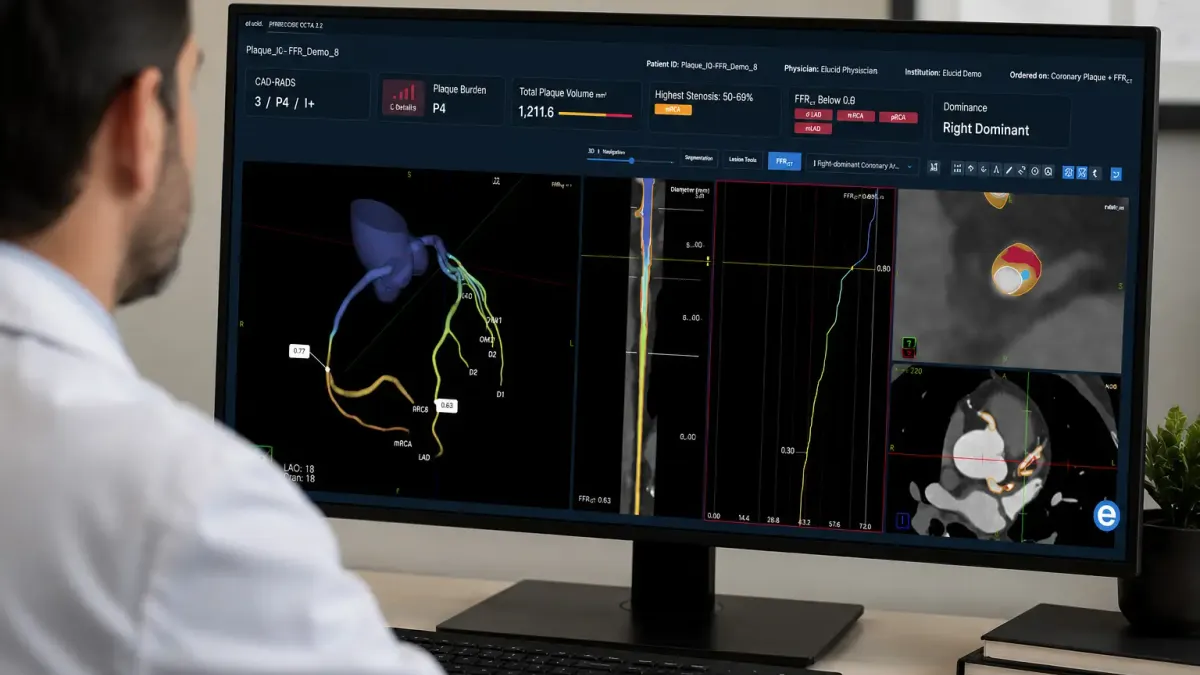
Boston-based medical technology innovator Elucid has announced a significant expansion of its commercial operations and clinical development pipeline, bolstered by a fresh influx of capital and a strategic partnership with a major, undisclosed medtech leader. This development comes as the company seeks to redefine the standard of care for cardiovascular diagnostics through its proprietary artificial intelligence (AI) platform, which provides unprecedented insights into arterial health. By integrating advanced imaging with biological analysis, Elucid aims to shift the paradigm of coronary artery disease (CAD) management from reactive treatment to proactive, personalized intervention.
The company’s growth trajectory is currently centered on two primary software solutions: Plaque-IQ, which received Food and Drug Administration (FDA) 510(k) clearance in 2024, and a secondary application for CT fractional flow reserve (FFR-CT), which is currently under active FDA review. The recent financing round, which included participation from high-profile investors such as IAG Capital Partners and Elevage Medical Technologies (a Patient Square Capital platform), has brought Elucid’s total funding to approximately $185 million. This capital is earmarked for the aggressive commercial scaling of the Plaque-IQ software and the preparation for a market launch of the FFR-CT tool, pending regulatory approval.
The Technological Foundation: Plaque-IQ and the Science of Morphology
At the heart of Elucid’s offering is Plaque-IQ, an AI-powered software-as-a-service (SaaS) platform designed to analyze coronary CT angiography (CCTA) images. While traditional imaging techniques often focus on the degree of stenosis—the physical narrowing of an artery—Plaque-IQ goes a step further by performing a detailed "virtual histology." This process allows the software to quantify and classify plaque morphology, identifying specific tissue types such as lipid-rich necrotic cores, intraplaque hemorrhage, and calcification.
The clinical significance of this capability cannot be overstated. In the field of cardiology, it is widely recognized that many heart attacks are caused not by the most severely narrowed arteries, but by the rupture of "vulnerable plaques" that may not significantly obstruct blood flow initially. By identifying these high-risk features noninvasively, Elucid provides clinicians with a "biopsy-like" understanding of a patient’s unique disease profile, enabling more accurate risk stratification.
The software utilizes deep learning algorithms trained against a massive database of histological samples—actual tissue analyzed under a microscope. This ensures that the AI’s interpretations are grounded in biological reality rather than just visual patterns. This "BioIntegrated" approach is what Elucid believes differentiates its platform from competitors who rely solely on geometric modeling of the blood vessels.
Expanding the Portfolio: The Push for FFR-CT Clearance
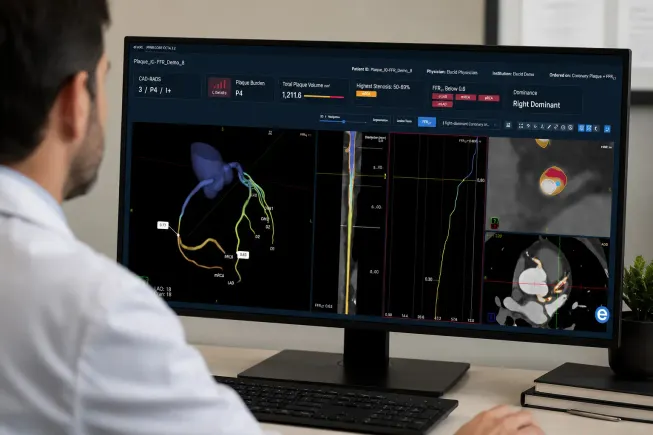
Building upon the success of its plaque analysis software, Elucid has submitted a 510(k) application to the FDA for its FFR-CT indication. Fractional Flow Reserve (FFR) is the gold standard for determining whether a coronary blockage is causing a significant restriction in blood flow (ischemia) that requires a stent or bypass surgery. Traditionally, FFR is measured invasively in a catheterization laboratory using a pressure-wire passed through the coronary arteries.
Elucid’s BioIntegrated FFR-CT product aims to provide this critical physiological data noninvasively. By applying computational fluid dynamics to the 3D models generated from CCTA scans, the software calculates the pressure drop across a lesion. What makes Elucid’s approach unique is the integration of plaque biology into these calculations. The company asserts that by accounting for the specific characteristics of the vessel wall and the plaque itself, its FFR-CT values may offer higher precision than models that treat the artery as a simple rigid pipe.
The pursuit of an FFR-CT indication places Elucid in direct competition with established players like HeartFlow, which pioneered the noninvasive FFR-CT market. However, Elucid’s leadership views their platform as a more comprehensive "one-stop-shop" for clinical decision support. By combining anatomy (3D modeling), biology (plaque characterization), and physiology (FFR-CT) in a single workflow, the company aims to provide a holistic view of the patient’s cardiovascular health.
Strategic Investment and the Role of Large Medtech
A notable highlight of the recent funding round is the participation of a "large medtech company" as a strategic investor. While the identity of the firm remains confidential, such investments typically signal a high degree of industry confidence in the underlying technology and its potential for widespread adoption. Strategic investors in this sector—often giants like Medtronic, Boston Scientific, or Abbott—frequently utilize venture arms to identify technologies that could eventually be integrated into their broader portfolios or lead to future acquisitions.
CEO Kelly Huang emphasized that this partnership is a testament to the industry’s shift toward more sophisticated, data-driven diagnostics. "Analogous to oncology’s shift from population-based, one-size treatment, Elucid is applying AI to integrate anatomy, biology, and physiology to bring personalized treatment to coronary artery disease management," Huang stated. This comparison to oncology highlights a broader trend in medicine: the move toward "precision medicine," where treatment plans are tailored to the specific molecular and structural characteristics of an individual’s disease.
A Landmark Shift in Reimbursement and Market Access
The commercial viability of any medical device is heavily dependent on its reimbursement status. In this regard, Elucid has achieved significant milestones that pave the way for broad clinical adoption. As of early 2026, the company reported that more than 70% of covered Americans now have insurance plans that pay for coronary plaque analysis.

This surge in coverage is driven by a series of positive decisions from both private payers and government entities. Major insurers, including Aetna, Humana, Cigna, and UnitedHealthcare, have updated their policies to include plaque analysis. Furthermore, the Centers for Medicare and Medicaid Services (CMS) has established pathways for reimbursement, recognizing the potential for these technologies to improve patient outcomes while potentially reducing long-term costs associated with emergency cardiac events and unnecessary invasive procedures.
The financial logic for payers is compelling. Cardiovascular disease remains the leading cause of death globally, accounting for nearly 20 million deaths annually. In the United States alone, the economic burden of heart disease is estimated to exceed $250 billion per year in direct healthcare costs and lost productivity. By accurately identifying patients who truly need intervention and those who can be managed safely with medication, AI-powered diagnostics like Plaque-IQ can help optimize resource allocation and reduce the volume of low-value cardiac catheterizations.
Chronology of Key Milestones
The development and scaling of the Elucid platform have followed a steady timeline of regulatory and financial achievements:
- Initial Development (Pre-2022): Elucid focuses on refining its AI algorithms using high-resolution histological data to ensure the accuracy of plaque characterization.
- Late 2023 – Early 2024: The company secures FDA 510(k) clearance for Plaque-IQ, marking its official entry into the clinical market for coronary plaque analysis.
- Mid-2024: Elucid expands its leadership team and begins building its commercial infrastructure to support a nationwide rollout.
- Late 2025: The company completes a major funding round, bringing total capital raised to $185 million and securing a strategic medtech investor.
- January 2026: Elucid announces that 70% of the U.S. insured population has access to reimbursed plaque analysis via its platform.
- Current (September 2026): The company awaits FDA clearance for its FFR-CT application while expanding its industry partnerships and international presence.
Market Implications and Future Outlook
The rise of Elucid and its AI-driven platform reflects a broader transformation in the medical imaging sector. The integration of "Big Data" and machine learning into radiology and cardiology workflows is no longer a futuristic concept but a present-day reality. For clinicians, these tools offer a way to manage the increasing volume of imaging data more efficiently, providing quantitative metrics that reduce the subjectivity inherent in visual interpretation.
For patients, the implications are profound. The ability to receive a comprehensive heart health assessment through a routine CT scan—avoiding the risks and recovery time associated with invasive angiography—is a major advancement in patient-centered care. As Elucid continues to gather real-world evidence of its platform’s efficacy, the focus will likely shift toward long-term outcome studies. Proving that AI-guided treatment strategies actually lead to fewer heart attacks and improved survival rates will be the final step in cementing these technologies as the new standard of care.
Looking ahead, Elucid’s expansion into FFR-CT and its strategic backing suggest that the company is positioning itself as a central node in the cardiovascular care continuum. Whether through continued independent growth or an eventual acquisition by a medtech conglomerate, Elucid’s technology is set to play a pivotal role in the ongoing battle against the world’s leading killer: heart disease. The combination of robust funding, favorable reimbursement, and a clear regulatory path puts the company in a formidable position to lead the next generation of cardiovascular diagnostics.
