

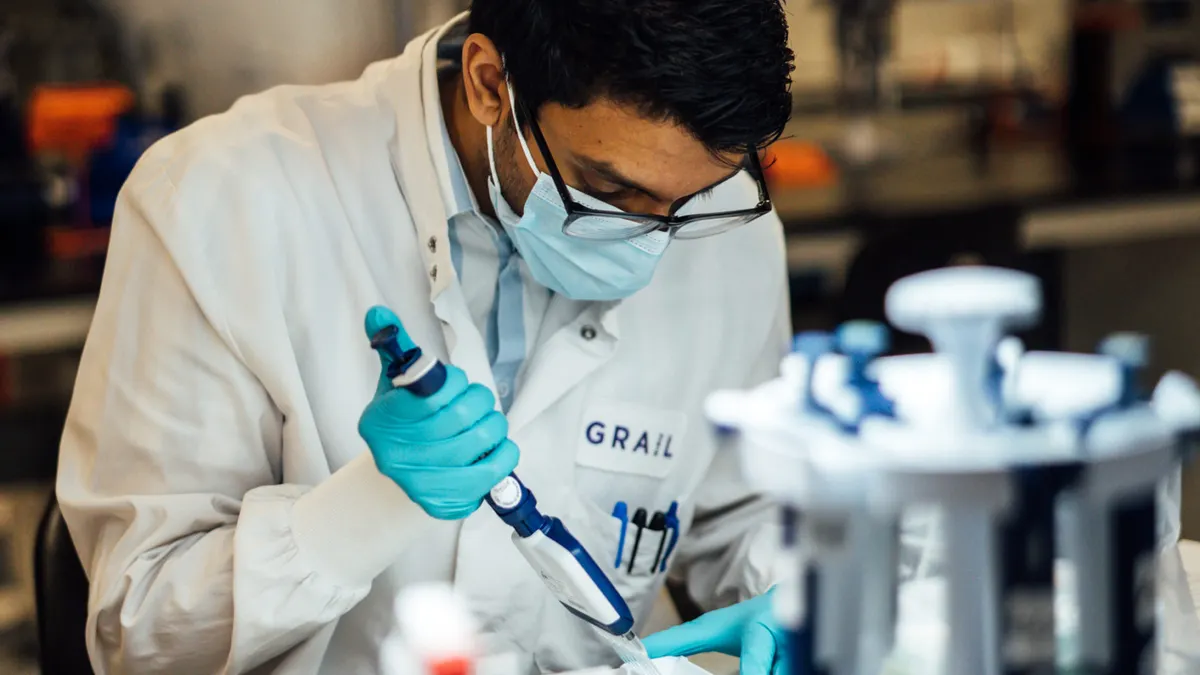
Grail, a pioneer in the field of multi-cancer early detection (MCED), has announced a significant leadership transition as it navigates a pivotal moment in its corporate history. Josh Ofman, the current president of the company, is set to succeed Robert Ragusa as Chief Executive Officer. This transition comes at a time when the company is managing the fallout from a high-profile clinical trial in the United Kingdom while simultaneously pushing for regulatory approval in the United States. According to the company, the appointment of Ofman is the result of a deliberate, long-term succession planning process intended to lead the organization through its next phase of commercial and clinical growth.
Robert Ragusa, the outgoing CEO, has been a central figure at Grail for over a decade. He joined the company in its early stages, serving as Chief Operating Officer for eight years before ascending to the top position in 2021. His tenure was marked by the complex integration and subsequent divestiture of Grail from Illumina, a saga that drew intense scrutiny from antitrust regulators in both the United States and the European Union. Ragusa’s leadership stabilized the company during these periods of corporate uncertainty, focusing on the operational scaling of the Galleri test, Grail’s flagship liquid biopsy product.
Josh Ofman brings a different profile to the executive suite, one deeply rooted in clinical strategy and biotechnology. Before joining Grail, Ofman held senior leadership roles at Amgen, one of the world’s largest independent biotechnology companies. Since joining Grail, he has served as Chief Medical Officer and later as President, roles in which he was instrumental in shaping the clinical evidence generated to support the Galleri test. His background is viewed by industry analysts as particularly relevant as Grail shifts its focus toward securing U.S. Food and Drug Administration (FDA) approval and expanding its footprint in the clinical oncology market.
The Context of the Leadership Change
The timing of the leadership announcement has drawn significant attention from the investment community, primarily due to its proximity to the release of data from a major trial conducted in partnership with the National Health Service (NHS) in England. The NHS-Galleri trial, which involved 142,000 asymptomatic participants between the ages of 50 and 77, was designed to evaluate whether the blood test could significantly reduce the rate of late-stage (Stage 3 and 4) cancer diagnoses by identifying malignancies earlier.
When the preliminary results were disclosed, the company revealed that the trial had failed to meet its primary endpoint of reducing the incidence of late-stage cancers. This news resulted in a sharp decline in Grail’s valuation, with share prices dropping by approximately 50% in the immediate aftermath. Despite this setback, Guggenheim Securities analysts have emphasized that the leadership change is "unrelated to the NHS trial readout." According to a note released to investors, the transition has been in the works for a considerable period and reflects the board’s confidence in Ofman’s ability to navigate the post-trial landscape.
Grail executives have maintained an optimistic outlook, pointing to secondary findings from the NHS trial that they believe demonstrate the test’s clinical utility. The company highlighted that the trial showed a four-fold increase in the cancer detection rate compared to standard-of-care screenings alone. Furthermore, the test demonstrated an ability to detect early-stage (Stage 1 and 2) cancers that are often fatal and currently lack effective screening protocols.
A Chronology of Grail’s Strategic Evolution
To understand the current state of Grail, one must look at the timeline of its development and its tumultuous relationship with its former parent company, Illumina.
- 2016: Grail is formed as a spin-off from Illumina, with significant backing from high-profile investors including Jeff Bezos and Bill Gates. Its mission is to develop a "liquid biopsy" capable of detecting dozens of types of cancer from a single blood draw.
- 2020-2021: Illumina announces its intention to re-acquire Grail for $8 billion. During this period, Robert Ragusa is appointed CEO, succeeding Hans Bishop. The acquisition proceeds despite vocal opposition from the Federal Trade Commission (FTC) and European regulators.
- 2021-2023: Grail operates as an Illumina subsidiary but is forced to remain separate under a "hold separate" order from the European Commission. Meanwhile, the NHS-Galleri trial begins in the U.K., marking the largest study of its kind.
- 2024: Following a protracted legal battle and orders from regulators to divest, Illumina completes the spin-off of Grail as an independent, publicly traded company.
- Late 2024 / Early 2025: The NHS trial results are announced, showing a miss on the primary endpoint. Shortly thereafter, the company announces Josh Ofman as the incoming CEO.
This chronology illustrates a company that has spent much of its existence in a state of corporate flux. With its independence now secured and a new CEO at the helm, the company is attempting to pivot from a research-heavy entity to a commercially viable diagnostic powerhouse.
The Galleri Test and the Path to FDA Approval
The primary objective for Josh Ofman will be navigating the rigorous FDA approval process. In January, Grail submitted a Premarket Approval (PMA) application to the FDA for the Galleri test. Currently, the test is available in the United States as a Laboratory Developed Test (LDT), meaning it can be ordered by physicians but is not yet FDA-approved or widely covered by most insurance providers.
The PMA process is notoriously lengthy and demanding, often taking several years to complete. For Grail, an FDA approval would be a transformative milestone, providing a "seal of approval" that is typically required for broad reimbursement from private insurers and Medicare. Without this coverage, the test remains a "private pay" option for most patients, significantly limiting its market reach.
The challenge for Ofman will be to use the existing data—including the nuances of the NHS trial—to convince regulators of the test’s safety and effectiveness. While the NHS trial did not meet its primary endpoint, Grail argues that the detection of early-stage cancers is the most critical metric for long-term survival. The company plans to present a more detailed analysis of the NHS data at the American Society of Clinical Oncology (ASCO) annual meeting in late May, an event that is expected to be a major catalyst for the company’s stock and reputation.
Market Reactions and Financial Implications
The financial community remains divided on Grail’s prospects. On one hand, the multi-cancer early detection market is estimated to be worth billions of dollars, as it addresses a massive unmet need in global healthcare. On the other hand, the high costs of clinical trials and the uncertainty of regulatory timelines present significant risks.
Guggenheim Securities’ assessment that the leadership change was pre-planned helped to soothe some investor concerns regarding internal stability. However, the 50% drop in share price following the NHS trial news indicates that the market is pricing in a longer, more difficult path to profitability. Analysts will be watching Ofman’s first few quarters as CEO closely to see if he can improve the company’s burn rate while maintaining its aggressive clinical development schedule.

Broader Impact on the Liquid Biopsy Industry
Grail’s leadership transition and its recent clinical results have implications that extend beyond the company itself. The entire liquid biopsy sector—including competitors like Exact Sciences, Freenome, and Guardant Health—is watching Grail’s experience with the FDA and the NHS.
If Grail successfully gains FDA approval despite the NHS trial’s primary endpoint miss, it could set a precedent for how MCED tests are evaluated. Regulators may shift their focus from "reduction in late-stage diagnoses" to "overall increase in early-stage detection," a change that would benefit the entire industry. Conversely, if Grail faces significant delays or requests for additional large-scale trials, it could cool investor interest in the sector for years to come.
The NHS’s ultimate decision on whether to adopt the Galleri test for routine use is also a critical factor. In 2021, the healthcare service suggested it could offer the test to up to one million people if the trial proved successful. While the primary endpoint was missed, the NHS has not yet made a final determination on the test’s future within the U.K. healthcare system. A partial adoption or a "coverage with evidence development" agreement remains a possibility.
Conclusion and Future Outlook
Josh Ofman inherits a company with a revolutionary product, a wealth of clinical data, and a recently cleared path as an independent entity. However, he also faces the daunting task of restoring investor confidence and satisfying federal regulators. His medical background and experience at Amgen suggest a CEO who will prioritize clinical rigor and strategic partnerships.
As the medical community looks toward the ASCO meeting in May, the focus will be on whether Grail can reframe the NHS trial results as a success for early detection rather than a failure of late-stage reduction. For Ofman, the coming months will define his legacy and determine whether Grail remains the leader in the race to transform cancer screening or becomes a cautionary tale of the complexities of modern biotechnology.
