








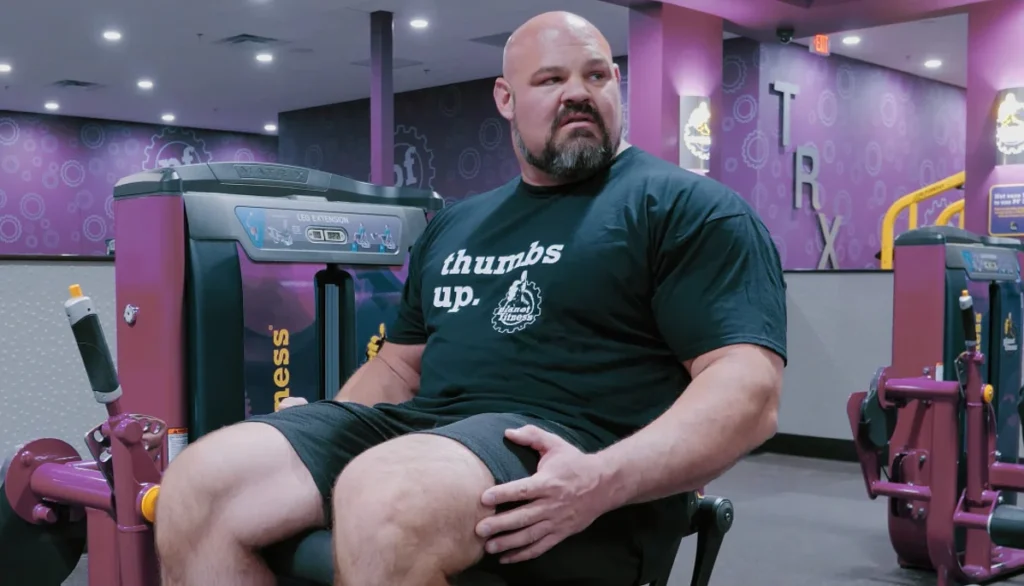
The landscape of modern strength sports is defined by a rigorous requirement for specialized equipment, often found only in high-performance centers or "hardcore" powerlifting warehouses. For elite athletes like Brian Shaw and Eddie Hall, whose daily routines involve moving hundreds of pounds of cold steel and granite, the typical commercial gym often lacks the necessary tools for their specific brand of hypertrophy and functional strength. However, in a move that blended athletic curiosity with content creation, two of the most decorated figures in the history of the World’s Strongest Man (WSM) competition recently descended upon a Planet Fitness location in Colorado to attempt a full leg-day routine.
The session, documented on Brian Shaw’s YouTube channel, served as a fascinating case study in the biomechanical and spatial limitations of standard commercial fitness equipment when subjected to the demands of world-class strength athletes. While Planet Fitness is globally recognized for its "Judgement Free Zone" and its focus on the general population, the presence of Shaw—a four-time World’s Strongest Man—and Hall—the 2017 champion and the first human to deadlift 500 kilograms—created a stark contrast between the gym’s intended utility and the extreme end of human physical capability.
The Cultural and Physical Mismatch: Strongmen vs. The Commercial Gym
To understand the logistical hurdles faced by Shaw and Hall, one must first examine the divergent philosophies of strongman training and commercial fitness franchises. Standard strongman training protocols rely heavily on "odd object" lifting, including Atlas stones, yokes, Husafell stones, and log presses. These movements require high-tensile flooring, significant square footage, and specialized implements that are rarely found in a chain gym.

Planet Fitness, by design, caters to the "deconditioned" or casual gym-goer. Their business model intentionally excludes certain high-intensity equipment, such as heavy dumbbells (usually capping at 60–75 pounds) and traditional squat racks, in favor of Smith machines and selectorized circuit equipment. This environment is famously guarded by the "Lunk Alarm," a siren intended to discourage grunting, plate-dropping, or "intimidating" behavior. For athletes like Hall and Shaw, whose training naturally involves significant noise and extreme loads, the environment presented a unique set of constraints.
Chronology of the Workout: Testing the Limits of the Smith Machine
The session began with the staple of any leg day: the squat. Due to the absence of free-weight squat racks, the duo was forced to utilize the Smith machine. This immediately presented a spatial challenge. Brian Shaw, standing 6 feet 8 inches tall and weighing well over 400 pounds, found the dimensions of the machine’s housing to be restrictive.
Despite the fixed plane of motion—which many strength athletes avoid due to the lack of stabilizer muscle engagement—the pair proceeded to load the machine. They eventually reached a weight of five 45-pound plates on each side of the bar. For Shaw, the physical width of his shoulders and the depth of his torso required him to manually stabilize the machine’s frame to ensure he could maintain proper form during the eccentric phase of the lift. Hall, while slightly shorter than Shaw, also faced difficulty fitting within the narrow confines of the machine’s safety rails.
Following the squats, the athletes moved to the abdominal crunch machine. This portion of the workout highlighted the ergonomic limitations of selectorized machines. These units are typically designed for individuals within the 50th to 95th percentile of height and weight. For men of Shaw and Hall’s stature, the pivot points and seat adjustments were insufficient, turning a standard core exercise into a struggle for basic positioning.
Maximizing the Leg Press and Isolation Machines
The leg press is often the centerpiece of a commercial gym’s leg equipment, and at Planet Fitness, the duo sought to find the "ceiling" of the machine’s capacity. They loaded the sled with six 45-pound plates on each side, supplemented by an additional plate placed on top of the apparatus.
Observers noted that while the weight was significant for a standard gym-goer, it represented only a fraction of the loads these athletes move in professional competition. For context, during his peak training, Eddie Hall has been known to leg press over 1,000 kilograms (approximately 2,200 pounds) for repetitions. Consequently, the challenge at Planet Fitness was less about the resistance and more about the volume and the speed of execution.
The workout continued through a series of isolation movements, including:
- Leg Extensions: Focusing on quad development through a fixed arc.
- Adductor and Abductor Machines: Exercises often overlooked in strongman training but utilized here to test the machine’s durability under maximum stack weights.
Throughout these exercises, the athletes had to modify their range of motion and tempo to compensate for the fact that they were "maxing out" the weight stacks on nearly every piece of equipment they touched.
The Competitive Finale: The 20-Station Circuit Race
To inject their signature competitive spirit into the session, Shaw and Hall concluded the day with a high-intensity race through the gym’s designated circuit training room. The challenge was simple but grueling: perform one repetition at the maximum possible weight on each of the 20 different machines in the room.
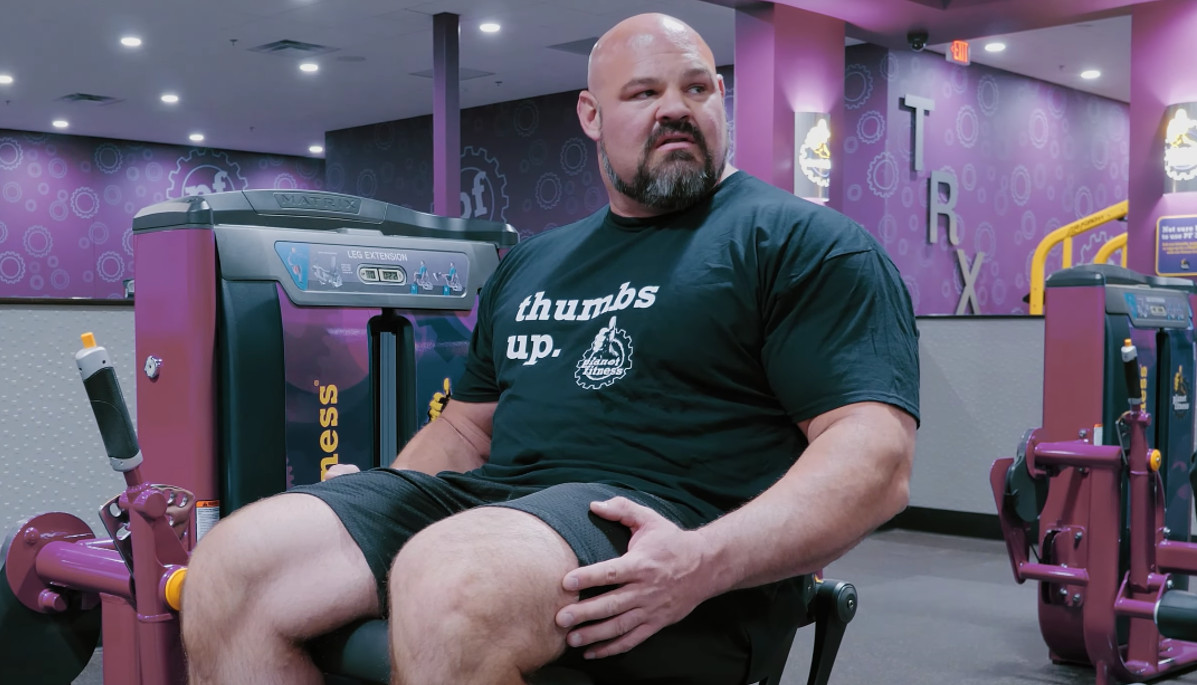
This "circuit race" served as a test of cardiovascular endurance and transitions. In the world of strongman, "medley" events—where athletes must move between different implements—are common, making this drill a familiar, albeit lighter, version of their professional requirements.
Eddie Hall showcased his explosive speed, completing the 20-station circuit in a time of 1:15.09. Brian Shaw, whose larger frame makes rapid transitions between small machines more difficult, followed closely with a time of 1:19. The narrow four-second margin underscored the competitive nature that has defined their decade-long rivalry and friendship.
Biomechanical Analysis: The Risks and Rewards of Suboptimal Training
From a sports science perspective, the decision for elite strongmen to train at a facility like Planet Fitness is rarely about optimal gains. Fixed-path machines, such as the Smith machine, can impose unnatural shearing forces on the knees and lower back if the user’s body doesn’t align perfectly with the machine’s predetermined track. For athletes carrying the sheer mass of Hall and Shaw, these risks are amplified.
However, there is a psychological and promotional value to such sessions. By operating in a "normal" environment, these athletes bridge the gap between the niche world of professional strength sports and the general public. It also serves as a reminder that consistency and effort often outweigh the specific brand of equipment available. As Shaw noted in the video, the goal was to "make it work" despite the environment’s limitations.
Context of the Event: Hall’s Return and Shaw’s Transition
This training session occurred at a pivotal time in both men’s careers. Brian Shaw was in the midst of his off-season, focusing on the growth of his own promotion, the Shaw Classic, and maintaining his status as one of the sport’s elder statesmen. Shaw’s career has been defined by a methodical, scientific approach to training, often involving custom-built equipment designed to handle his massive frame.
In contrast, Eddie Hall was preparing for a significant return to the competitive stage. After retiring from the World’s Strongest Man circuit following his 2017 victory, Hall spent several years pursuing other ventures, including a high-profile boxing match against rival Hafthor Björnsson.
At the time of this workout, Hall was preparing to captain Team UK at the "World’s Strongest Nation" contest, held in November 2022 at the M&S Bank Arena in Liverpool. This competition pitted a team of British athletes against a Team USA led by 2019 WSM champion Martins Licis. Hall’s training at Planet Fitness, while unconventional, was part of a broader effort to regain the "strongman engine"—the ability to move weight quickly and efficiently under fatigue.
Public Reaction and Impact on the Fitness Community
The footage of the workout garnered significant attention online, highlighting the "fish out of water" element of the scenario. Reactions from the fitness community were largely positive, with many praising the athletes for their humility and for not actually triggering the "Lunk Alarm," despite their massive size and the heavy weights being moved.
The event also sparked discussions regarding gym accessibility for oversized athletes. In the United States, the average gym is built for a specific demographic. When individuals who are 6’8" and 400+ pounds enter these spaces, the lack of adjustable, heavy-duty equipment becomes a glaring issue. This has led to a rise in "private" or "key-club" style gyms that offer specialized equipment for powerlifters and strongmen.
Broader Implications for the Strength Industry
The "Strongmen at Planet Fitness" narrative is more than just a viral moment; it reflects the growing mainstream popularity of strength sports. Ten years ago, the names Brian Shaw and Eddie Hall were known only to a small subset of lifting enthusiasts. Today, through social media and documentaries, they have become household names in the broader fitness world.
Their ability to walk into a mainstream commercial gym and draw a crowd—while simultaneously highlighting the limitations of that gym’s equipment—illustrates the divide between "fitness for health" and "fitness for performance." While Planet Fitness succeeds in its mission to provide a low-barrier entry point for exercise, the presence of Hall and Shaw serves as a reminder of the extreme heights human strength can reach, and the specialized environments required to foster that level of development.
As Eddie Hall moved toward his captaincy for Team UK and Brian Shaw continued to cement his legacy in the sport, this Colorado workout remained a testament to the versatility of elite athletes. It proved that while a world-class athlete might prefer a world-class facility, the heart of a champion is defined by the ability to train anywhere, under any conditions, and still find a way to compete.