Medtronic PLC, a global leader in medical technology, has officially received 510(k) clearance from the U.S. Food and Drug Administration (FDA) for its Hugo robotic-assisted surgery (RAS) system to be used in general surgery procedures. This regulatory milestone marks a significant expansion of the platform’s utility in the United States, following its initial clearance for urologic procedures in late 2023. By securing this authorization, Medtronic strengthens its position in the rapidly evolving soft-tissue robotics market, aiming to challenge the long-standing dominance of Intuitive Surgical’s da Vinci system and navigate an increasingly crowded field of competitors including Johnson & Johnson and Stryker.
The FDA’s decision allows Medtronic to market the Hugo system for a variety of general surgical applications, which may include hernia repairs, gallbladder removals, and other abdominal procedures. This move is strategically vital for Medtronic, as general surgery represents one of the largest and fastest-growing segments within the robotic-assisted surgery landscape. The company has indicated that general surgery has already surpassed urology and gynecology as the highest growth area for the Hugo system in international markets where it has been available for several years.
Strategic Significance in the U.S. Market
The introduction of the Hugo system into the U.S. general surgery market ends a period of relative stagnation in terms of primary competition for soft-tissue robotics. Since the launch of the da Vinci system by Intuitive Surgical in 2000, the U.S. market has seen few major challengers achieve widespread adoption. Medtronic’s entry as the first large-scale medtech conglomerate to offer a viable alternative signifies a shift toward a multi-vendor environment.

Medtronic’s strategy centers on its "ecosystem" approach. Unlike standalone robotic platforms, Hugo is designed to integrate with Medtronic’s established portfolio of surgical instruments. For decades, the company has provided tools for open and laparoscopic procedures, such as the LigaSure vessel-sealing technology. By enabling surgeons to use familiar high-performance instruments within a robotic framework, Medtronic aims to lower the barrier to adoption and provide a seamless transition for surgical teams moving from traditional minimally invasive surgery to robotic-assisted platforms.
A Chronology of Soft-Tissue Robotics Development
The journey to this FDA clearance has been a multi-year effort characterized by intensive research, development, and international clinical trials.
- September 2019: Medtronic first unveiled the Hugo RAS system to investors and the public, positioning it as a modular, portable alternative to the large, integrated systems then on the market.
- October 2021: The Hugo system received the CE Mark in Europe, allowing for its use in urologic and gynecologic procedures across the European Union.
- December 2023: Medtronic achieved its first major U.S. regulatory hurdle when the FDA cleared the Hugo system for urologic procedures, specifically targeting prostatectomies and other kidney-related surgeries.
- July 2024: Johnson & Johnson MedTech received FDA authorization for its Ottava system, signaling the arrival of another major diversified healthcare player in the space.
- August 2024: Stryker entered the soft-tissue robotics arena through a $400 million investment and distribution agreement with CMR Surgical for the Versius robot.
- Late 2024: Medtronic secures FDA clearance for general surgery, effectively broadening its total addressable market in the U.S. by thousands of procedures annually.
Technical Innovations and Modular Design
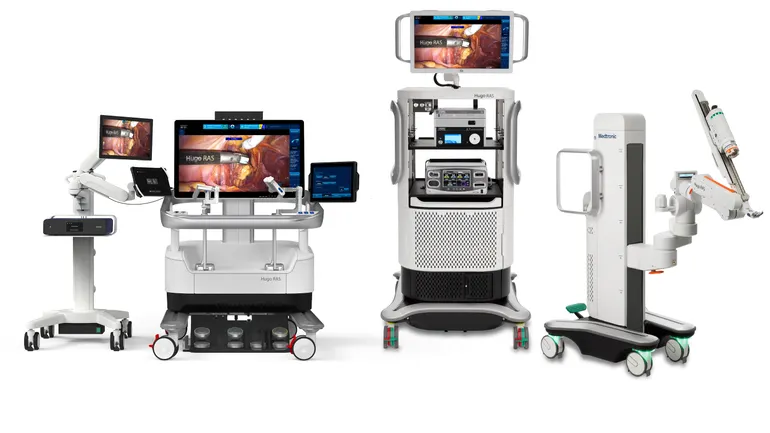
The Hugo system is distinguished by its modular, four-arm configuration. Unlike the da Vinci system, which typically features a single large patient-side cart with multiple arms attached, the Hugo system utilizes individual carts for each robotic arm. This design is intended to offer hospitals greater flexibility, allowing the system to be moved between operating rooms and configured specifically for the needs of different surgical specialties.
The system also features an "open" console design, which allows surgeons to maintain a direct line of sight with their surgical team and the patient while operating. This is a departure from the "closed" immersive consoles used by some competitors. Furthermore, Medtronic has integrated its Touch Surgery Enterprise platform into the Hugo workflow. This AI-powered surgical video and analytics platform allows surgeons to record, analyze, and share videos of their procedures, facilitating better training and quality control.
The recent clearance specifically highlights the compatibility of the Hugo system with Medtronic’s LigaSure technology. LigaSure has been a staple in operating rooms for over 20 years, known for its ability to seal vessels up to 7mm in diameter with minimal thermal spread. Integrating this into the robotic platform allows for precise tissue management that mirrors the tactile feedback and reliability surgeons expect from laparoscopic tools.
Market Data and Performance Projections
Medtronic’s expansion into general surgery comes at a time when the global robotic surgery market is projected to reach nearly $10 billion by the end of the decade. According to internal data provided by the company, procedure growth for the Hugo system is currently trending at more than twice the rate of the overall robotic surgery market.
Medtronic is on track to exceed 50,000 global procedures by the end of its current fiscal year. The company reports that the uptick is driven primarily by international adoption in regions such as Europe, Latin America, and parts of Asia. With the addition of general surgery clearance in the U.S., these numbers are expected to accelerate. Analysts note that while Intuitive Surgical still holds the vast majority of the market share, the demand for secondary and tertiary robotic options is high among hospital procurement officers looking to manage costs and increase surgical throughput.
The financial implications are significant. Robotic systems are often sold under capital-intensive models or through long-term lease agreements that include recurring revenue from disposable instruments and service contracts. By expanding the clinical indications for Hugo, Medtronic increases the "utilization rate" of the robots already placed in hospitals, making the capital investment more attractive to healthcare administrators.
Perspectives from Leadership
Matt Anderson, senior vice president and president of Medtronic’s surgical business, emphasized the role of the Hugo system in addressing modern healthcare challenges. In a statement following the clearance, Anderson noted that the system provides a "practical option" for hospitals facing capacity constraints.
"Hugo expands choice with a practical option to help hospitals address capacity and access challenges, while giving surgical teams more flexibility to meet patients’ needs across care settings," Anderson said. He further elaborated that the goal is to bring the benefits of robotic-assisted surgery—such as smaller incisions, reduced blood loss, and shorter hospital stays—to a broader patient population that might currently only have access to traditional laparoscopy.
Industry analysts suggest that Medtronic’s focus on "flexibility" and "access" is a direct response to the high costs and space requirements associated with first-generation robotic systems. By offering a system that can be unbundled or reconfigured, Medtronic is positioning itself as a partner for mid-sized hospitals and ambulatory surgery centers (ASCs), not just large academic medical centers.
Competitive Dynamics and Broader Implications
The FDA clearance for Hugo in general surgery intensifies the "robotic wars" between the world’s largest medical device manufacturers. For the first time in two decades, Intuitive Surgical faces simultaneous pressure from three giants: Medtronic, Johnson & Johnson, and Stryker.
- Intuitive Surgical: Remains the incumbent with the deepest clinical data set and the most established training infrastructure. However, the company must now innovate more aggressively to maintain its market lead as competitors offer lower-cost or more modular alternatives.
- Johnson & Johnson: With its Ottava system, J&J is leveraging its massive Ethicon surgery business. Like Medtronic, J&J is focusing on the integration of its proprietary instruments into a robotic platform.
- Stryker: By partnering with CMR Surgical, Stryker is bypassing the lengthy internal R&D process to bring the Versius system to the U.S. market. Stryker’s existing dominance in orthopedic robotics (Mako) gives it a strong foothold in hospital boardrooms.
The broader implication for the healthcare industry is a potential reduction in the "robotic premium"—the extra cost associated with using a robot versus traditional surgery. Increased competition usually leads to more aggressive pricing on instruments and service contracts. For patients, this competition likely means increased access to minimally invasive options. While robotics has become the standard of care for urology (such as radical prostatectomies), its penetration in general surgery is still relatively low in many parts of the country.
Future Outlook
Looking ahead, Medtronic is expected to seek further clearances for gynecology and thoracic surgery to match the full suite of indications offered by the da Vinci system. The company is also heavily investing in digital surgery and artificial intelligence. Future iterations of the Hugo system are expected to include real-time intraoperative guidance and automated performance metrics, which could help standardize surgical outcomes regardless of a surgeon’s experience level.
The successful rollout in the U.S. general surgery market will serve as a litmus test for Medtronic’s ability to convert its massive install base of laparoscopic customers into robotic users. If the company can maintain its current growth trajectory, the Hugo system will likely become a cornerstone of Medtronic’s surgical portfolio, contributing significantly to its long-term revenue targets and shaping the future of operative care.