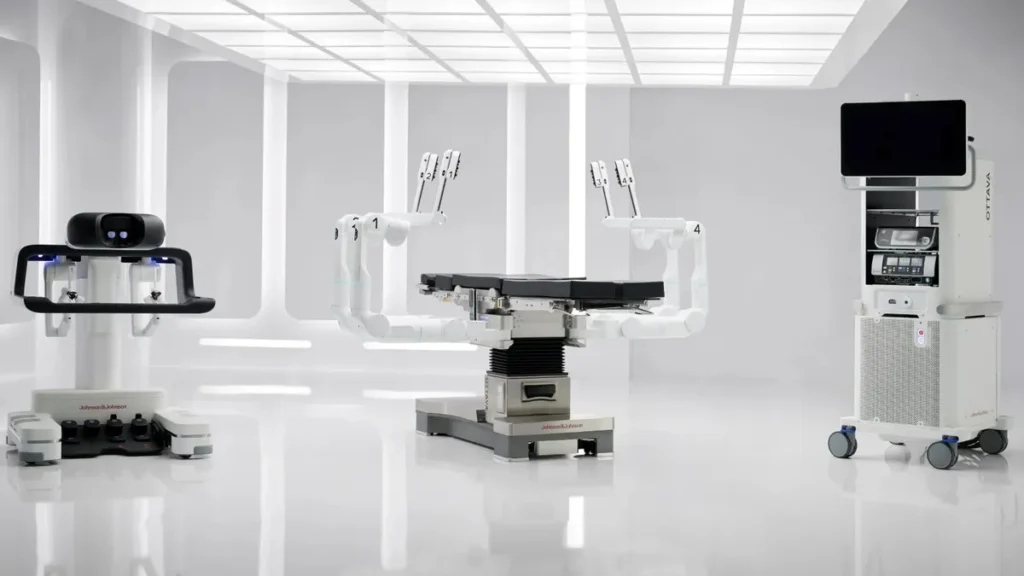
Johnson & Johnson MedTech has reached a definitive commercial agreement with Memorial Hermann-Texas Medical Center to deploy its Ottava robotic surgical system, marking the first major hospital partnership for the platform following its recent regulatory milestones. This announcement comes at a pivotal moment for the healthcare conglomerate as it intensifies its efforts to challenge the long-standing market dominance of Intuitive Surgical and keep pace with recent advancements from rival Medtronic. The partnership with Memorial Hermann—a leading academic medical center in Houston—represents a critical validation of the Ottava system’s design, which aims to address the spatial and operational constraints that have historically hindered the widespread adoption of robotic-assisted surgery in smaller or more crowded operating environments.
The commercial rollout follows the Ottava system’s receipt of de novo authorization from the U.S. Food and Drug Administration (FDA) in July 2026. This regulatory green light cleared the platform for use in ten specific general surgery procedures within the upper abdomen, providing J&J with a strategic entry point into the high-volume soft-tissue surgery market. The timing of the agreement is particularly significant, as it coincides with Medtronic’s announcement of expanded FDA clearance for its Hugo robotic system, which was recently authorized for general surgical procedures in the upper abdomen. As the "Big Three" of surgical robotics—Intuitive, Medtronic, and Johnson & Johnson—converge on similar clinical indications, the competition for hospital contracts and surgeon loyalty is expected to reach unprecedented levels of intensity.
A Strategic Partnership in the Heart of Houston
The selection of Memorial Hermann-Texas Medical Center as the inaugural commercial site for Ottava is a calculated move by Johnson & Johnson. The facility served as a primary clinical trial site during the Ottava system’s Investigational Device Exemption (IDE) program, which provided the essential data used to support the FDA’s authorization. By transitioning from a trial site to a commercial partner, Memorial Hermann provides J&J with a "center of excellence" that can serve as a showcase for the system’s real-world utility and efficiency.

Hani Abouhalka, Company Group Chairman of Surgery at Johnson & Johnson MedTech, emphasized that the agreement is more than a simple equipment sale; it is a collaborative effort to redefine the surgical workflow. The hospital’s surgeons, who have already gained experience with the platform during the clinical phase, are positioned to lead the integration of the technology into routine practice. This familiarity is expected to reduce the "learning curve" hurdles that often accompany the introduction of new robotic platforms, allowing for a faster transition to full-scale clinical use.
Technical Innovation: The "Table-Integrated" Advantage
One of the primary differentiators for the Ottava system is its physical architecture. Unlike traditional robotic systems that utilize large, standalone carts that must be wheeled into position and docked with the surgical table, Ottava features four robotic arms that are integrated directly into a standard-sized surgical table. This design philosophy is aimed at solving the "footprint" problem that plagues many modern operating rooms (ORs).
In many older hospital facilities, ORs were not designed to accommodate the massive footprint of first-generation robotic systems. The integration of the robotic arms into the table itself allows for a more flexible use of space, providing the surgical team with 360-degree access to the patient. This "invisible" design is intended to make the robot an extension of the OR rather than an obstacle within it. According to J&J executives, this layout not only saves space but also simplifies the setup and teardown process, potentially increasing the number of procedures a hospital can perform in a single day.
Furthermore, the Ottava system utilizes Ethicon’s industry-leading surgical instruments. Ethicon, a subsidiary of Johnson & Johnson, has a decades-long history of providing manual and laparoscopic tools to surgeons worldwide. By incorporating familiar Ethicon end-effectors and energy devices into the Ottava platform, J&J is leveraging surgeon brand loyalty and reducing the cognitive load required for clinicians to switch from manual surgery to robotic-assisted procedures.
The Regulatory Journey and Clinical Scope
The July 2026 FDA de novo authorization was the culmination of years of development and significant investment. The authorization specifically covers ten procedures in the upper abdomen, which are among the most common surgeries performed in the United States. These include:
- Roux-en-Y Gastric Bypass: A complex weight-loss surgery that involves creating a small pouch from the stomach and connecting it directly to the small intestine.
- Gastrectomy: The partial or total removal of the stomach, often used in the treatment of gastric cancer.
- Cholecystectomy: The surgical removal of the gallbladder, one of the most frequently performed robotic procedures.
- Splenectomy: The removal of the spleen.
- Gastric Sleeve: A bariatric procedure that reduces the stomach to about 15% of its original size.
- Small Bowel Resection: The removal of a diseased portion of the small intestine.
- Appendectomy: The removal of the appendix.
- Lysis of Adhesions: The surgical destruction of internal scar tissue that can cause pain or bowel obstructions.
- Fundoplication: A procedure used to treat gastroesophageal reflux disease (GERD).
- Hiatal Hernia Repair: The correction of a condition where the upper part of the stomach bulges through the diaphragm.
By securing clearance for this broad range of procedures, J&J is positioning Ottava to be a workhorse in general surgery departments. While Intuitive’s Da Vinci system has a much broader range of clearances across urology, gynecology, and thoracic surgery, J&J’s strategy appears to be focusing on high-volume abdominal work to establish a foothold before expanding into other specialties.
Navigating a Fierce Competitive Landscape
The robotic surgery market, currently valued at over $8 billion and projected to grow at a double-digit compound annual growth rate (CAGR) through 2030, is no longer a one-player game. For nearly two decades, Intuitive Surgical enjoyed a virtual monopoly with its Da Vinci system. However, the landscape has shifted dramatically in the last five years.
Medtronic, the world’s largest medical device company, has been aggressively rolling out its Hugo RAS (Robotic-Assisted Surgery) system. Just days before J&J announced its deal with Memorial Hermann, Medtronic received expanded FDA clearance for Hugo in general surgical procedures. Previously, Hugo was primarily limited to urologic and gynecologic procedures in the U.S. This head-to-head expansion into general surgery puts Medtronic and J&J on a direct collision course for the same hospital budgets.
Meanwhile, Intuitive Surgical is not standing still. The company recently launched the Da Vinci 5, which features enhanced force-sensing technology and significantly more computing power than previous iterations. The competition is driving a "tech war" in the OR, with each company attempting to prove that its system provides better patient outcomes, shorter recovery times, and lower total cost of care for the hospital.
Economic and Operational Implications for Hospitals
The adoption of robotic systems like Ottava is driven as much by economics as by clinical outcomes. Hospitals are currently facing a "perfect storm" of challenges: rising labor costs, a shortage of specialized nursing staff, and increasing pressure to reduce the length of patient stays.

J&J argues that Ottava addresses these pressures by improving "workflow predictability." Because the robot is integrated into the table, the time required to "dock" the robot—a process that can be time-consuming and physically demanding for staff—is minimized. If a hospital can shave 15 to 20 minutes off the turnover time between surgeries, it can potentially add an extra procedure to the daily schedule, significantly impacting the hospital’s bottom line.
Additionally, the ergonomic benefits for surgeons are a key selling point. Traditional laparoscopy often requires surgeons to stand in awkward positions for hours, leading to physical strain and career-shortening injuries. Robotic consoles allow surgeons to sit in an ergonomic position with high-definition 3D visualization, which J&J believes will help hospitals retain talent and reduce surgeon burnout.
Timeline of Development: From Concept to Commercialization
The road to the Memorial Hermann agreement has been long and complex. J&J’s foray into soft-tissue robotics began in earnest with its 2019 acquisition of Auris Health for $3.4 billion, which brought in the expertise of robotic pioneer Dr. Fred Moll. This was followed by the full acquisition of Verb Surgical, a joint venture originally started with Alphabet (Google).
The Ottava project faced several internal delays and "re-alignments" as J&J sought to perfect the table-integrated design. In 2021, the company announced a multi-year delay in the platform’s development timeline to refine the hardware and software integration. By 2024, the company had successfully moved into the IDE clinical trial phase, culminating in the 2026 FDA authorization. The current commercial agreement marks the transition from the "development and testing" phase to the "revenue-generating" phase of the product lifecycle.
Future Outlook: Expansion and Digital Integration
Looking ahead, Johnson & Johnson MedTech plans to expand the Ottava platform’s indications to include colorectal and thoracic surgery, which would bring it into even more direct competition with Intuitive Surgical. The company is also heavily investing in the "digital ecosystem" surrounding the robot. This includes AI-driven surgical video analysis, which can help surgeons review their performance and provide real-time guidance based on data from thousands of previous procedures.
The commercial agreement with Memorial Hermann-Texas Medical Center is likely the first of many announcements expected in the coming months as J&J targets major hospital systems across the United States. As the MedTech giant leverages its massive global sales force and existing relationships with hospital procurement departments, the surgical robotics market is entering a new era of plurality. For healthcare providers, this competition is likely to result in more favorable pricing models and a faster pace of technological innovation, ultimately benefiting the millions of patients who undergo abdominal surgery each year.