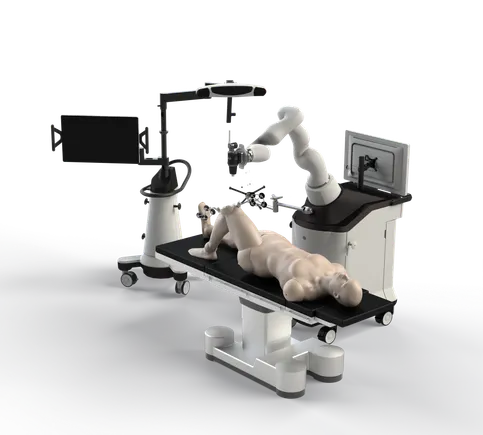
Zimmer Biomet has significantly moved forward its timeline for the integration of fully autonomous surgical technology into the orthopedic market, targeting a 2027 commercial launch for its newly acquired Monogram Technologies robotic system. This strategic acceleration follows the company’s 2025 acquisition of Monogram for $177 million, a move designed to augment Zimmer’s existing robotics portfolio and address the growing demand for precision-guided, hands-free surgical interventions. The Monogram system, which utilizes advanced computed tomography (CT) imaging and active milling capabilities, represents a departure from the company’s current flagship robot, Rosa, and signals a broader industry shift toward "active" robotics where the machine performs specific surgical tasks under surgeon supervision rather than merely providing navigation or haptic boundaries.
Strategic Acquisition and Technical Differentiation
The acquisition of Monogram Technologies in 2025 marked a pivotal moment for Zimmer Biomet as it sought to diversify its technological offerings. While Zimmer’s Rosa system has established a significant footprint in the orthopedic market, it primarily operates as a collaborative tool that provides navigation and haptic feedback to guide a surgeon’s manual movements. In contrast, the Monogram technology was founded on the principle of "active milling." This allows the robot to execute bone cuts autonomously based on a pre-operative plan derived from high-resolution CT scans.
The primary differentiator for the Monogram system is its reliance on CT imaging. Most contemporary robotic systems in orthopedics utilize either image-less technology or 2D X-rays to create intraoperative maps. By utilizing CT data, the Monogram system allows for a more detailed assessment of bone quality and morphology before the patient even enters the operating room. This data is then translated into a customized surgical plan where a robotic arm, controlled via foot pedals rather than manual manipulation, performs the precise bone preparation required for total knee replacement.
The transition from semi-autonomous to fully autonomous functionality is the core focus of the current development phase. The semi-autonomous version required significant surgeon interaction, but the upcoming iteration aims for a "hands-free" experience. This evolution is intended to standardize surgical outcomes, reducing the variability often associated with manual bone preparation and traditional instrumentation.
Clinical Performance and Surgeon Feedback
Recent clinical trial data has bolstered Zimmer Biomet’s confidence in the technology. In presentations led by CEO Ivan Tornos, the company highlighted that trial results for the Monogram robot showed no reported safety events, a critical milestone for any autonomous medical device seeking regulatory clearance. Beyond safety, the trials indicated that the robot significantly expedited the process of landmarking and bone preparation.
At a recent Stifel healthcare conference, a panel of orthopedic surgeons provided further insight into the practical implications of the Monogram system. The consensus among the experts was that the technology offers "meaningful time savings" in the operating room. Currently, a significant portion of a total knee arthroplasty (TKA) involves the manual setting of jigs and cutting blocks. By automating the bone-cutting process, the robot can potentially shave minutes off the procedure time while ensuring a level of accuracy that is difficult to replicate manually.
Furthermore, the surgeons noted that the system could lead to a dramatic reduction in the number of instrument trays required for a procedure. In traditional surgery, multiple trays of specialized tools must be sterilized, transported, and organized. An autonomous robot that performs the majority of the bone preparation could consolidate these requirements, leading to lower sterilization costs and improved logistics for hospital operating suites.
Another critical factor discussed was the reduction of physical strain on the surgeon. Orthopedic surgery is notoriously labor-intensive, often requiring significant physical force to position limbs and perform bone resections. The move to a foot-pedal-activated, autonomous milling system could extend the careers of surgeons by reducing the cumulative physical toll of performing multiple high-volume procedures daily.
Chronology of Development and Regulatory Pathway
The journey of the Monogram system from a startup concept to a cornerstone of Zimmer Biomet’s future strategy has been marked by several key milestones:
- 2023–2024: Monogram Technologies gains traction in the medtech sector with its prototype active milling robot, attracting interest from major orthopedic players looking to leapfrog current haptic-based systems.
- Early 2025: Zimmer Biomet officially acquires Monogram Technologies for $177 million. The deal is structured to integrate Monogram’s software and hardware capabilities into Zimmer’s broader digital ecosystem, known as ZBEdge.
- Late 2025 – 2026: Intensive clinical validation and iterative design phases. Zimmer focuses on refining the "hands-free" interface and ensuring the software can seamlessly interpret CT data for a variety of patient anatomies.
- Early 2027: Zimmer Biomet submits a 510(k) application to the U.S. Food and Drug Administration (FDA). This submission is categorized as a 90-day review cycle, though the company acknowledges the potential for "back and forth" due to the novel nature of the autonomous technology.
- Mid-to-Late 2027: The projected commercial launch window. This timeline is a full year ahead of the original 2028 estimate provided at the time of the acquisition.
The regulatory environment remains one of the most significant variables. Ivan Tornos has been transparent about the challenges of bringing "new-to-the-world" technology to market. The FDA has traditionally been cautious with autonomous systems in the surgical space, typically requiring robust data to prove that an autonomous cut is as safe as, or safer than, a surgeon-guided cut. Zimmer’s strategy involves leveraging the 510(k) pathway by demonstrating substantial equivalence to existing robotic-assisted devices while highlighting the specific safety protocols built into the Monogram software.
Market Context and Competitive Landscape
The orthopedic robotics market is currently an "arms race" between four major entities: Stryker, Zimmer Biomet, Johnson & Johnson (DePuy Synthes), and Smith & Nephew. Stryker’s Mako system has long been the market leader, utilizing a haptic-arm technology that also relies on CT scans. However, Mako remains a surgeon-driven system. Zimmer’s move toward a fully autonomous, hands-free milling robot is an attempt to disrupt this hierarchy by offering a higher level of automation.
The shift toward CT-based robotics is also a significant strategic pivot. While image-less systems (like Smith & Nephew’s Cori) are popular because they avoid the cost and radiation of a CT scan, many surgeons argue that CT-based planning is superior for complex cases or for patients with significant bone loss. By offering both the Rosa (which can be image-less) and the Monogram (which is CT-based), Zimmer Biomet positions itself to capture the entire spectrum of surgeon preferences.
Economic factors are also driving adoption. Hospitals are increasingly looking for ways to improve throughput. If Zimmer can prove that the Monogram system reduces total procedure time and instrument overhead, the "total cost of care" argument becomes very compelling for hospital administrators, despite the initial high capital expenditure required to purchase the robot.
Broader Implications for the Future of Surgery
The 2027 launch of the Monogram system is expected to be a bellwether for the wider adoption of autonomous technology in medicine. If successful, it could pave the way for similar applications in spine surgery, hip replacements, and even soft-tissue procedures.
The integration of AI and machine learning into the Monogram platform is another area of long-term potential. As the robot performs more procedures, the data collected can be used to refine surgical algorithms, potentially allowing the system to "learn" the most efficient cutting paths for different bone densities and patient profiles. This fits into Zimmer Biomet’s "ZBEdge" vision, where data from pre-operative planning, intraoperative robotics, and post-operative recovery (tracked via wearable devices like the Persona IQ smart knee) are synthesized to provide a holistic view of patient outcomes.
However, the transition to autonomous robotics also raises questions about surgeon training and the "de-skilling" of the profession. Proponents argue that the robot is a tool that enhances the surgeon’s capabilities, much like an autopilot system in an aircraft, allowing the human operator to focus on high-level decision-making while the machine handles the repetitive, precision-heavy tasks. Zimmer Biomet has emphasized that the surgeon remains the ultimate authority in the operating room, with the ability to override or pause the robot at any millisecond via the foot-pedal control.
Conclusion and Outlook
Zimmer Biomet’s decision to pull forward the launch of the Monogram system reflects a high degree of confidence in the technology’s readiness and its potential market impact. By targeting 2027, the company is signaling to investors and competitors alike that it intends to lead the next generation of surgical robotics.
The $177 million investment in Monogram Technologies appears to be a calculated risk aimed at securing a first-mover advantage in fully autonomous bone preparation. As the 510(k) submission nears, the industry will be watching closely to see how the FDA navigates the safety profile of hands-free robotics. If the projected benefits of increased accuracy, reduced physical strain, and faster procedure times materialize, the 2027 launch could mark the beginning of a new era in orthopedic surgery—one where the precision of the machine and the expertise of the surgeon are more closely integrated than ever before.